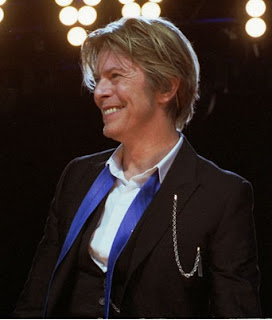
Showing posts with label David Bowie. Show all posts

Friday, June 25, 2021

Classic Rock Review: David Bowie's Pinups (1973)

https://amzn.to/2RJq0o7
In 1973, British teens were deeply in the grip of “glam-rock,” with David Bowie and Marc Bolan of T.Rex sitting atop of a cultural phenomenon that included hitmakers like Slade, Sweet, Cockney Rebel, Mott the Hoople, and Roxy Music as well as a legion of lesser-known bands. Glam even paddled its way onto U.S. shores in the forms of Lou Reed, Suzi Quatro, and the New York Dolls. Bowie himself was riding high with three U.K. Top Ten albums (Hunky Dory, Ziggy Stardust, and Aladdin Sane), the latter two of which also struck gold stateside.

David Bowie’s Pinups

While Bowie was working on a vaguely-defined concept album based on George Orwell’s post-war dystopian novel Nineteen Eighty-Four (elements of which he’d weave into 1974’s Diamond Dogs), Bowie enlisted guitarist Mick Ronson and bassist Trevor Bolder from his former backing band the Spiders From Mars, along with Bluesbreakers drummer Aynsley Dunbar, to record a label-pacifying “stopgap” collection of cover tunes. With a track list comprised of mid-to-late ‘60s British records that Bowie loved as a younger man, Pinups was designed with an eye towards wooing teenaged American fans unfamiliar with the original versions of the songs.

Critics unfairly assailed Pinups, many writing that Bowie’s renditions of songs by the Pretty Things, Them, the Yardbirds, the Who, and others weren’t as good as the originals. Blah, blah, blah…these reviews missed the point, really, as Bowie performed these personal faves not with mindless mimicry of the originals but rather in his own unique fashion, reinterpreting them as he saw fit. He retained enough of the original flavor and melodic hooks to reel in listeners, but delivered them with passion and energy that created an irresistible playlist that appealed to fans like catnip. For many of us Bowie fans at the time, this was the first we heard some of these songs, prompting many to go out and look up the originals. It’s safe to say that the Pretty Things won over more than a few new fans stateside after hearing Bowie singing “Don’t Bring Me Down” or “Rosalyn.”

Like usual, Bowie was ahead of the trends, recording an album of cover songs as a lark at the peak of his 1970s-era commercial success. Truthfully, though, Pinups is a good album by any standard of rock ‘n’ roll. The aforementioned PT’s song “Rosalyn” takes the band’s basic blues-infused garage-rock blueprint, spins the tempo up to punk-rock levels of energy, and lets Ronson cut loose with his dynamic, razor-sharp riffing. The song quickly jumps into a tearful reading of Them’s “Here Comes the Night” which captures all the blue-eyed soul and heartbreak of Van Morrison’s original, while the Yardbirds’ cover of Billy Boy Arnold 1955 song “I Wish You Would” is all but shorn of its Chicago blues roots in favor of a piercing Ronson guitar riff and an uncompromising and fiercely reckless arrangement.

Sorrow

Classic rock legend David Bowie

The Mojos – which counted Aynsley Dunbar among their early members – are one of the more obscure choices here, and the band’s “Everything’s Alright” builds upon the song’s British Invasion roots with a glammed-up arrangement heavy on Bowie’s vocal gymnastics and Dunbar’s tribal rhythms. The Who’s “I Can’t Explain” veers delightfully onto Roxy Music turf with a slowed-down, almost languid performance punctured by cacophonic blasts of saxophone. Bowie raids the Peter Townshend songbook again for “Anyway, Anyhow, Anywhere,” the singer playing it straight down the line with a close-to-the-sleeve vocal performance wrapped around Dunbar’s Keith Moon-styled drum pyrotechnics.   
 
The mournful “Sorrow,” which had been a U.K. chart hit for both the McCoys in 1965 and the Merseys in ’66, was the break-out song from Pinups, and while it rose to #3 on the U.K. charts (#1 in Australia!), it found only a few diehard fans in the U.S. Bowie’s rendition is superior to either of the previous versions, offering the perfect balance of lovelorn melancholy and creative risks (in Bowie’s gorgeous multi-tracked vocals). By contrast, the Easybeats’ “Friday On My Mind” displays Bowie’s chameleonlike ability to take on different musical styles with ease, the singer delivering a spry and energetic pop-styled vocal riding atop Ronson’s scorching guitar licks. The Yardbirds’ “Shapes of Things” was another fetching tune that prompted young fans to seek out the original, Bowie balancing art and tradition with a reckless and joyful vocal performance. 

In spite of the critical barbs levied on it at the time, Pinups has weathered the decades since its release. Placed in the context of Bowie’s lengthy career – which spanned six decades and better than two dozen studio albums – Pinups is seen as a bona fide artistic triumph. With Pinups, Bowie stamped “paid” on his glam-rock persona, allowing the artist to extend himself musically wherever he chose to go. What the critics don’t know, the fanboys understand, and Pinups carried on Bowie’s commercial winning streak, topping the U.K. albums chart, hitting Top 30 in the U.S. and setting the stage for the enormous success of the following year’s Diamond Dogs. (RCA Records, 1973)

Buy the CD from Amazon: David Bowie’s Pinups

Friday, June 1, 2018

CD Review: Beside Bowie The Mick Ronson Story soundtrack (2018)

Even during an era of guitar heroes, Mick Ronson was exceptional, albeit underrated. Born in Kingston upon Hull, England Ronson was classically-trained as a pianist as a child, but was inspired to pick up a guitar after becoming enamored with early rocker Duane Eddy’s distinctive “twangy” sound. A veteran of various 1960s and ‘70s-era British rock bands (most notably The Rats), Ronson’s star began its ascent when he became an essential part of David Bowie’s short-lived Ziggy-era “Spiders From Mars” band. Ronson lent his six-string talents to such groundbreaking Bowie albums as 1971’s Hunky Dory, 1972’s classic The Rise and Fall of Ziggy Stardust and the Spiders From Mars, and 1973’s Aladdin Sane and Pin Ups.

When Bowie broke up the “Spiders,” Ronson launched his solo career with a pair of critically acclaimed albums in 1974’s Slaughter On 10th Avenue and 1975’s Play Don’t Worry. Neither disc sold particularly well and a third solo album, recorded in 1976, was subsequently shelved and Ronson dropped from the label. The guitarist soldiered on, however, recording and performing with his longtime friend Ian Hunter (Mott the Hoople) and serving as a “gun for hire” for stars like Bob Dylan, Lou Reed, and John Mellencamp. Ronson would also become an in-demand producer as well, working with artists as diverse as Midge Ure, Morrisey, the Rich Kids, and Slaughter and the Dogs, among others, before his tragic death in 1993 at the too-young age of 46 years. All of this history is recounted in the 2017 documentary film, Beside Bowie: The Mick Ronson Story, for which this CD and vinyl release serves as a soundtrack of the guitarist’s life.

Beside Bowie: The Mick Ronson Story


Beside Bowie: The Mick Ronson Story is essentially bookended by Ronson’s performance as part of the all-star crew appearing at The Freddie Mercury Tribute Concert for AIDS Awareness. Held in April 1992 – a mere year before Ronson’s death from liver cancer – the concert included members of Mercury’s band Queen as well as Bowie, Ronson, Hunter, and Def Leppard’s Joe Elliott and Phil Collen, among many others. Two songs are culled from that show, the first being a raucous performance of the classic “All the Young Dudes,” the Bowie-penned song that revived Mott the Hoople’s career in 1972. With all the hoopla surrounding the live performance of the revered Hoople song, it’s hard to pick out Ronson’s contribution from the fray, which isn’t necessarily the case with the epic live reading of Bowie’s “Heroes” that appears later on the album. Although Ronson was long gone from Bowie’s band by the time that the rock ‘n’ roll legend recorded “Heroes” (with guitarist Robert Fripp of King Crimson), his familiar wiry fretwork drives the performance’s inherent grandeur.

Far more intimate a portrait of Ronson’s immense talents can be heard on a track by British folk-rock legend Michael Chapman, whose “Soulful Lady” successfully blends Chapman’s not inconsiderable guitar skills with Ronson’s distinctive leads from an early session for Chapman’s 1970 album Fully Qualified Survivor. A lengthy alternative version of Elton John’s classic 1970 song “Madman Across the Water” features Ronson’s imaginative acoustic and electric guitar playing; it’s a damn shame that it wasn’t released on the original album, showing up years later as a bonus track and on rarities compilations. Ronson’s long-standing friendship with Ian Hunter is represented by Hunter’s popular solo track “Once Bitten, Twice Shy” which offers Ronson’s particularly jaunty git licks. More of this, please!

Ziggy’s Moonage Daydream


Mick Ronson's Slaughter On 10th Avenue
Joe Elliott’s previously-unreleased “This Is For You” was written in tribute to the universally-beloved guitarist, but its rather sedate performance is a real snooze. Ditto for pianist Mike Garson’s tepid instrumental “Tribute to Mick Ronson” which, however heartfelt, is nevertheless a somnambulant ending to an otherwise dynamic collection. The heart and soul of Beside Bowie can be found in four tracks taken from Ronson’s three extant solo albums along with three Bowie tracks that prominently feature the young man from Hull. Although the point of the documentary film is that Mick Ronson was so much more than his work with Bowie, there’s no denying the power of the performances created by the two men. Naturally, Bowie’s “Moonage Daydream” has to be included in any story written about Ronson, his electrifying fretwork melding with Bowie’s otherworldly vocals to create a rare bit of musical magick.

“Cracked Actor,” a favorite from Bowie’s 1973 album Aladdin Sane, is another bit of rock ‘n’ roll finery, a guitar-driven melody welded to a foot-tapping rhythm while the lesser-known Bowie track “Time,” also from Aladdin Sane, displays Ronson’s subtle side. Curiously, all four of Ronson’s solo tracks here were taken from posthumous albums released in 1994 (Heaven and Hull) and 1999 (Just Like This) – nothing from his earlier solo efforts. Recorded in 1976 as Ronson’s third solo album, but not released until ’99, Just Like This offers the excellent “Hard Life,” a muscular, melodic rocker with stellar guitar playing including a Ziggy-ish solo that soars above the mix. A cover of Dylan’s “Like A Rolling Stone,” from the acclaimed Heaven and Hull album, showcases Ronson’s six-string abilities in his familiar role as sideman, expertly backing up Bowie’s vox on the classic song. A pallid cover Giogio Moroder’s languid instrumental “Midnight Love,” where Ronson plays all the parts, would have best been replaced by anything from Ronson’s earlier solo albums.

The Reverend’s Bottom Line


Not having seen Beside Bowie: The Mick Ronson Story documentary film (yet), I can’t speak with certainty how representative this “soundtrack” album may be to the music actually included in the film, but I see how this CD could easily have been expanded into a two-disc set. Any of Ronson’s contributions to recordings by Lou Reed, John Mellencamp, Bob Dylan, or Roger McGuinn could have been included here, and we could have used more Bowie (with whom he recorded five studio albums) and Hunter (appearing on four studio albums).

That minor cavil aside, while the hardcore Ronson fan already has almost all of these songs, it’s nice to get them on one disc (or two vinyl LPs), and for newcomers to the music and magic that was Mick Ronson, Beside Bowie offers a rock solid introduction to the guitarist’s talent and charm, opening the door for the musically curious to Ronson’s underappreciated solo albums as well as his timeless work with Bowie and Hunter. Grade: A- (Universal Music, released June 8, 2018)

Buy the vinyl LP from Amazon.com: Beside Bowie The Mick Ronson Story


Sunday, April 29, 2018

CD Preview: Beside Bowie: The Mick Ronson Story

Beside Bowie The Mick Ronson Story
We have a fondness for guitarists here at That Devil Music.com world HQ, and few more so than the late Mick Ronson. An integral part of the sound of David Bowie’s “Ziggy Stardust” era, Ronson would go on to play alongside legends like Bob Dylan, Lou Reed, and John Mellencamp and the guitarist also had a lengthy friendship with former Mott the Hoople frontman Ian Hunter, playing on a number of Hunter’s solo albums during the 1970s and ‘80s. Ronson had also built a significant solo career before his untimely death 25 years ago, in April 1993, releasing a trio of critically-acclaimed albums including a bona fide classic in 1974’s Slaughter On 10th Avenue.

In 2017, filmmaker Jon Brewer unveiled Beside Bowie: The Mick Ronson Story, a feature-length documentary film about the guitarist’s life and career that enjoyed a limited theatrical run before its release on DVD and streaming via Hulu and Amazon Prime. Brewer, who had previously made documentary films on B.B. King and Jimi Hendrix, lined up some heavy hitters for his Ronson movie, which features narration by David Bowie and exclusive contributions from Ian Hunter, Def Leppard’s Joe Elliott, Queen’s Roger Taylor, and Rick Wakeman of Yes, among others.

On June 8th, 2018 Universal Music will release Beside Bowie: The Mick Ronson Story, The Soundtrack, a fourteen-song collection to compliment Brewer’s documentary film. Known to his friends as “Ronno,” the de facto movie soundtrack features songs from Ronson’s various collaborations with artists like David Bowie, Ian Hunter, Elton John, and Michael Chapman as well as a handful of the guitarist’s solo tracks. The album also includes a previously-unreleased cover version of “This Is For You” by Joe Elliott, as well as a piano tribute to Ronson by former Bowie keyboardist Mick Garson, who has also played with Nine Inch Nails and Smashing Pumpkins.

Mick Ronson's Slaughter On 10th Avenue
Beside Bowie: The Mick Ronson Story, The Soundtrack also features a live performance of Mott the Hoople’s “All The Young Dudes” from the 1992 Freddie Mercury Tribute Concert For AIDS Awareness held at Wembley Stadium in London that includes members of Queen, Bowie and Ronson, and Def Leppard’s Elliott and Phil Collen. The soundtrack includes a lengthy essay and liner notes and will be released on CD and heavyweight 180-gram black vinyl as well as a digital download. A limited edition red vinyl version of the album is available exclusively from the uDiscover website.

Mick Ronson was an imaginative and innovative guitarist whose work inspired a generation of British rockers to follow. If you’re not familiar with Ronson’s work, Beside Bowie: The Mick Ronson Story, The Soundtrack seems like a great place to start! The full tracklist for the album is provided below along with a handy Amazon.com link to buy a vinyl copy (that's the version I'm gonna buy!) of this long-overdue tribute to a great artist.

Buy the vinyl LP from Amazon.com: Beside Bowie: The Mick Ronson Story, The Soundtrack

Beyond Bowie: The Mick Ronson Story, The Soundtrack track listing:
1. Queen, Ian Hunter, David Bowie, Mick Ronson, Joe Elliott & Phil Collen – “All The Young Dudes” [live]
2. Michael Chapman – “Soulful Lady”
3. Elton John – “Madman Across The Water”
4. David Bowie – “Moonage Daydream”
5. David Bowie – “Cracked Actor”
6. David Bowie – “Time”
7. Ian Hunter – "Once Bitten, Twice Shy"
8. Mick Ronson – “I’d Give Anything To See You”
9. Mick Ronson – “Hard Life”
10. Mick Ronson – “Midnight Love”
11. Mick Ronson – "Like A Rolling Stone"
12. Joe Elliott – “This Is For You” *
13. Queen, David Bowie and Mick Ronson – “Heroes” [live]
14. Mike Garson – “Tribute To Mick Ronson” *

* Previously unreleased


Thursday, June 1, 2017

New Music Monthly: June 2017 Releases

It's hard to believe, but another 30 days have passed by and it's time to roll up your coins, cash in those pop bottles, and raid the piggy bank to go out and buy some new music! June promises to be the best month yet in 2017 as far as new music, with anticipated albums from Dan Auerbach of the Black Keys, Roger Waters (ex-Pink Floyd), punk legends Rancid, blues giant Joe Bonamassa and Chicago's Cash Box Kings, among others. Throw in some very cool reissue and archive releases from the likes of Prince, Jesse Ed Davis, Game Theory, Bob Marley, and David Bowie as well as vinyl reissues from Alex Chilton and the Spinto Band, and June may be the month that breaks the bank...

Dan Auerbach's Waiting On A Song

JUNE 2
Dan Auerbach - Waiting On A Song   BUY!
Benjamin Booker - Witness   BUY!
Jesse Ed Davis - Red Dirt Boogie: The Atco Recordings 1970-1972   BUY!
Hawkwind - Live Chronicles   BUY!
Bob Marley & the Wailers - Exodus 40: The Movement Continues   BUY!
U2 - The Joshua Tree: 30th Anniversary   BUY!
Roger Waters - Is This The Life We Really Want?   BUY!
 

Game Theory's 2 Steps From The Middle Ages

JUNE 9
Game Theory - 2 Steps From The Middle Ages   BUY!
Rainbow - Live In Birmingham   BUY!
Rancid - Trouble Maker   BUY!


JUNE 16
Chuck Berry - Chuck   BUY!
Alex Chilton - Take Me Home & Make Me Like It [vinyl]   BUY!
David Bowie - Cracked Actor: Live In Los Angeles 1974   BUY!
Steve Earle - So You Wannabe An Outlaw   BUY!
Fleet Foxes - Crack-Up   BUY!
Jason Isbell & the 400 Unit - The Nashville Sound   BUY!
Spinto Band - Nice and Nicely Done [vinyl reissue]   BUY!

Prince's Purple Rain

JUNE 23
Joe Bonamassa - Live at Carnegie Hall   BUY!
King Gizzard & the Lizard Wizard - Murder of the Universe   BUY!
Glenn Morrow - Cry For Help   BUY!
Prince - Purple Rain Deluxe   BUY!
Jeff Tweedy - Together At Last   BUY!
 

Chris Bell's Looking Forward

JUNE 30
Chris Bell - Looking Forward (pre-Big Star recordings)   BUY!
The Cash Box Kings - Royal Mint   BUY!
Willie Nile - Positively Bob: Willie Nile Sings Bob Dylan   BUY!


Chuck Berry's Chuck

Album of the Month: Chuck Berry's Chuck...the rock 'n' roll pioneers first studio album in nearly 40 years is already garnering rave reviews, and whether as comeback album or a self-conscious goodbye, Berry's legacy is already indelibly carved in granite. Chuck offers up ten mostly new, original songs produced by Berry, who is backed by both his children – guitarist Charles Berry Jr. and harmonica player Ingrid Berry – as well as his longtime stage band from the Blueberry Hill Club in St. Louis. Heck, it's Chuck Berry...what more do you need to know?

Saturday, April 1, 2017

Record Store Day 2017 Preview

Record Store Day 2017 is a mere three weeks away, falling on Saturday, April 22nd this year. As usual, both independent and major labels are flooding the market with a bunch of slick, shiny (and high-priced) vinyl relics designed to separate record collectors from their hard-earned pesos.

We’d be remiss if we didn’t offer some sort of preview of the holiday, so after poring over the massive RSD17 release list, the Reverend has personally ‘curated’ the below listed discs as those most likely to tickle the itch of any That Devil Music reader. Remember – ‘round these parts, every day is “record store day”! Support your local independent music retailer…

The list below is organized alphabetically by artist, with the size of the release (one disc, two, etc) and the number of copies of each limited edition LP (5000x, etc) included.


David Bowie – Cracked Actor (3xLP, 5000x)
Rhino Records dug deep into the vaults to find this previously unreleased live recording from David Bowie’s Diamond Dogs tour in September 1974. The album’s title comes from a 1975 BBC television documentary film that followed Bowie during his series of concerts in Los Angeles. Whereas the producers of the film used concert footage from the September 2nd, 1974 performance, Cracked Actor the album uses a recording from September 5th and was produced by Bowie before his death and mixed by Tony Visconti. The three-album vinyl set features etching on the sixth side.  

R.L. Burnside – Long Distance Call (LP, 2500x)
Reissue of 1982 recordings made in Groningen, Netherlands by producer Leo Bruin (founder of Swingmaster Records) and originally released on CD stateside by Fat Possum in 2000 as Mississippi Hill Country Blues. A stunning solo performance by legendary bluesman R.L. Burnside – just the man and his guitar – this is the first time these eleven sides have been offered on vinyl in the U.S.

Marianne Faithful – Rich Kid Blues (LP, 2000x)
Recorded in 1971 and originally released in the U.K. on CD by Diablo Records in 1998 (and again in 2003), Marianne Faithful’s Rich Kid Blues reunites the singer with producer Mike Leander, who had arranged and recorded much of Faithful’s 1960s-era material for the Decca Records label. A low-budget affair, the album offers Faithful’s haunting acoustic readings of folk-rock songs by artists like Bob Dylan, Phil Ochs, James Taylor, Sandy Denny, and Tim Hardin, among others. This is the first time on vinyl for Rich Kid Blues.

Hawkwind – The Best of the United Artists Years: 1971-1974 (LP, 2500x)
There is certainly no lack of Hawkwind material to be found on the band’s early recordings and half-dozen (or more) compilation CDs that have been culled from the Hawk’s prolific and productive stint with United Artists Records circa 1971 to ’74. This eight-track LP offers up some of the best recordings from the psychedelic space-rock pioneers, including rare and alternative versions of songs from their studio albums like a live 1971 performance of the classic “Silver Machine” from the Roundhouse. This limited edition RSD release is pressed on swirl color vinyl and was manufactured by Pallas Group in Germany on audiophile-grade vinyl.

Jimi Hendrix's Live At George's

Jimi Hendrix/Curtis Knight – Live At George’s Club 20 (2xLP, 3000x)
First legit vinyl release collecting raw live performances by the rock guitar great with bandleader Curtis Knight, recorded in December 1965 and January 1966, not long before Hendrix’s discovery by Animals bassist Chas Chandler. Live At George’s Club 20 offers up raucous R&B and blues covers of classic songs by Muddy Waters, Jimmy Reed, Ray Charles, and others. A lot of this material was previously released by dodgy fly-by-night labels through the years, usually by Knight himself, but this specially priced two-disc set is offered by Dagger Records, the official bootleg label created by the Hendrix estate and restored by producer Eddie Kramer to their original status. 

Robert Johnson's The Complete Recordings

Robert Johnson – The Complete Recordings: The Centennial Collection (3xLP, 2500x)
Delta blues legend Robert Johnson only made a total of 42 recordings during two sessions in 1936 and ’37, but they have been circulated endlessly over the past 50+ years, providing a blueprint for contemporary blues and blues-rock music. These influential, inspiring tracks have been recycled more than once, most recently on the centennial of Johnson’s birthday in 2011, when they were re-mastered and reissued on CD (and thumb drive!). This three-album limited edition set is drawn from those improved 2011 recordings and packaged in a deluxe gatefold jacket and includes extensive liner notes as well as a bonus poster with the original label artwork of Johnson’s 78rpm singles released in the 1930s and ‘40s by labels like Vocalion, Orion, Conqueror, and others. 

Ken Kesey's The Acid Test

Ken Kesey – The Acid Test (LP, 2000x)
Writer and ‘60s counterculture icon Ken Kesey was, perhaps, the best-known of the loose-knit group of friends called the Merry Pranksters whose experimentation with psychedelic drugs like LSD were immortalized in Tom Wolfe’s 1968 book The Electric Kool-Aid Acid Test. The 1966 album The Acid Trip was a private label release that was intended to recreate the vibe of an LSD trip for listeners. Allegedly Kesey, Ken Babbs, and other Merry Pranksters were tripping in the studio with members of the Grateful Dead and came up with this cultural curiosity, roughly 30 minutes of humorous spoken word, music parody, and rambling instrumental jams that probably made a lot of sense at the time.

Motorhead's Clean Your Clock


Motörhead – Clean Your Clock (2xLP, 1500x)

Lemmy may have left the planet in December 2015 but his music is eternal. Clean Your Clock is being billed as a ‘RSD exclusive’ but that’s stretching it a bit. Recorded live at the Zenith in Munich, Germany during Motörhead’s 2015 “Bad Magic Tour,” this performance was released on CD, DVD, and vinyl in 2016. This RSD release is a two-LP picture disc set, though, which is pretty cool in and of itself.

Iggy Pop's Post Pop Depression

Iggy Pop – Post Pop Depression: Live at the Royal Albert Hall (3xLP, 1200x)
Prior to the great David Bowie’s death in January 2016, his friend and fellow rock ‘n’ roll legend Iggy Pop revisited the music the two of them had made back in the late ‘70s with a live performance at the Royal Albert Hall in London. Backed by a band that included Josh Homme and Dean Fertitia of Queens of the Stone Age and Arctic Monkeys’ drummer Matt Helders, Pop performed songs from albums like The Idiot and Lust For Life. This RSD ‘exclusive’ seems to be an expanded version of the 2016 CD and DVD release, packaged in a four-sleeve, book-style individually-numbered gatefold with a sixteen-page book featuring exclusive photos.

Lou Reed's Perfect Night

Lou Reed – Perfect Night: Live In London (2xLP, 3000x)
A semi-acoustic live album recorded by Reed during the Meltdown ’97 festival in London, England and originally released on CD in 1998, Perfect Night gets its first vinyl reissue for Record Store Day. Reed performs a stellar set, including a version of the Velvet Underground’s “I’ll Be Your Mirror,” originally sung by Nico, as well as solo material like “Coney Island Baby,” “New Sensations,” and the awesome title track.

John Sinclair's Mobile Homeland

John Sinclair – Mobile Homeland (LP, 1200x)
Blues artist, poet, political activist, and 1960s-era cultural hero John Sinclair released Mobile Homeland on CD in 2016, so this is essentially the vinyl reissue of the collection of Sinclair’s beat poems set to music and produced by Tino Gross at Funky D Records in Detroit.

Sun Ra – Janus (LP, 2000x)
Reissue of space-jazz innovator Sun Ra’s 1999 compilation CD features recordings dating from 1963 to 1970 that includes both studio tracks and wild live performances. I haven’t heard this one, but informed sources tell the Reverend that while it’s not a great introduction to the almighty Mr. Ra, it’s a “must have” disc for the hardcore faithful.
 
Peter Tosh's Legalize It

Peter Tosh – Legalize It! (LP, 2000x)
Vinyl reissue of reggae great Peter Tosh’s 1976 debut album features the former Wailers member’s awesome title track as well as songs like “Why Must I Cry” (written with Bob Marley) and the original “Ketchy Shuby.”

John Trudell's AKA Graffiti Man

John Trudell – AKA Graffiti Man (2xLP, 2000x)
Reissue of the American Indian activist and poet’s 1992 sophomore album features Trudell’s erudite spoken-word pieces set to a rock ‘n’ roll soundtrack with elements of indigenous folk music. Several songs were co-written by Jesse Ed Davis and tracks like “Rockin’ the Res,” “Baby Boom Che,” and the title song earned the artist a truckload of critical acclaim back in the wild ‘n’ wooly alternative 1990s.

Towns Van Zandt – Live at Austin City Limits (LP, 2500x)
The late Texas-bred songwriting legend was inducted into the Austin City Limits ‘Hall of Fame’ in 2015 and this RSD exclusive release features Van Zandt’s 1976 appearance on the long-running TV show, performing country-tinged folk-blues songs like “Dollar Bill Blues,” “Talkin’ Karate Blues,” “The Ballad of Ira Hayes,” and “Fraternity Blues.” Highly recommended if you like eloquent songwriting and haunting solo performances.  

Link Wray's Beans and Fatback

Link Wray – Beans and Fatback (LP, 2400x)
Guitar great Link Wray is best-known for his enduring classic 1958 instrumental “Rumble,” which inspired a rash of U.K. fretburners like Eric Clapton, Peter Townshend, Jeff Beck, and Jimmy Page. By the late ‘60s, though, Wray was an afterthought in a market flush with blues-drenched rockers. Beans and Fatback, recorded at the same time as the guitarist’s self-titled 1971 “comeback” album, was released in 1973 to critical acclaim. A raucous collection of hard-rockin’, whiskey-soaked songs recorded in a chicken coup, the album led to the pairing of Wray and rockabilly revivalist Robert Gordon for a series of late ‘70s LPs.

Record Store Day 2017 also offers up a bunch of interesting 7” and 10” releases along with the above-listed full-length albums, including discs from Steve Earle, the Drive-By Truckers, the Old 97s, the Kinks, Patti Smith, the Zombies, and Sharon Jones & the Daptones, among many others. Check out the entire list on the Record Store Day website and get your pennies ready to spend on April 22nd!

Saturday, December 31, 2016

In Memoriam 2016: Mose Allison to Jimmy Guterman

David Bowie, photo by Adam Bielawski/Photobra
David Bowie photo by Adam Bielawski/Photobra
This year was absolutely brutal for musicians…in a normal year, I sadly have to write up a couple dozen ‘end-of-year’ obituaries; for 2016, I had over 70 musicians, writers, and producers to memorialize. Our “In Memoriam” feature is so large this year that I’ve broken it down into three parts, with each artist's age at death in parentheses. To follow is in tribute to the artists that have made the music we love…

Part Two: Georgio Gomelsky to Alphonse Mouzon
Part Three: Prince to Bernie Worrell


Mose Allison (89)
American jazz and blues pianist Mose Allison was also a gifted songwriter who penned such classics as “Parchman Farm” and “A Young Man’s Blues.” During the 1950s Allison worked in New York City as a jazz pianist, performing and recording with legends like Stan Getz, Al Cohn, and Zoot Sims. As Allison began incorporating more blues into his music, he would straddle both worlds and appeal to fans of both jazz and blues genres. As a songwriter, Allison’s songs have been recorded by artists as diverse as the Who, John Mayall’s Bluesbreakers, Leon Russell, Bonnie Raitt, Van Morrison, and the Clash and his musical influence reached such unlikely fans as Jimi Hendrix, the Rolling Stones, and Georgie Fame, among others.

Signe Anderson (74)
Anderson was the original vocalist for the San Francisco-based band Jefferson Airplane. Born Signe Toly, she was a well-respected jazz and folk singer when she married Jerry Anderson, one of Ken Kesey’s Merry Pranksters. Asked by singer/songwriter Marty Balin to join Jefferson Airplane, Anderson would sing on the band’s 1966 debut album, Jefferson Airplane Takes Off. Anderson quit the band later that year, performing her final shows with the Airplane in October. Moving to Oregon, Anderson continued to sing through the years with various bands, including Carl Smith and the Natural Gas Company. Anderson died on the same day as her former Jefferson Airplane bandmate Paul Kantner.

Jimmy Bain photo by Dana Wullenwaber
Jimmy Bain (68)
An underrated musician who contributed to the work of many better-known artists, Scotland’s Jimmy Bain is best known as an integral member of the classic rock bands Rainbow and Dio. Bain first came to prominence with the London-based band Harlot, where he came to the attention of Deep Purple’s Ritchie Blackmore, who was looking for a new bass player for his band Rainbow. Bain performed on the band’s 1976 album Rising and would appear on the following year’s On Stage live album. Fired from Rainbow, Bain formed Wild Horses with former Thin Lizzy guitarist Brian Robertson, the bassist singing and writing material for the band’s two EMI label records at the dawn of the ‘80s.

Close friends with Thin Lizzy’s Phil Lynott, Bain played keyboards and co-wrote songs for Lynott’s two solo albums, 1980’s Solo In Soho and 1981’s The Phillip Lynott Album. During this period Bain also performed on albums by Roger Chapman (Family), Roy Harper, Gary Moore, and Kate Bush before reuniting with former Rainbow vocalist Ronnie James Dio in his new band Dio. Bain wrote or co-wrote several songs during his tenure with Dio, performing on the band’s Holy Diver (1983), The Last In Line (1984), Sacred Heart (1985), and Dream Evil (1987) albums.

After leaving Dio, Bain was a member of a number of bands, including World War III (with vocalist Mandy Lion), the Hollywood All Starz, and 3 Legged Dog, the latter two with former Dio drummer Vinny Appice. Bain later formed Last In Line in 2013 with former Dio bandmates Appice and guitarist Viv Campbell, performing classic Dio songs. Bain died while on Def Leppard’s “Hysteria on the High Seas” cruise with Last In Line, his death originally attributed to a lengthy bout with pneumonia but actually the result of undiagnosed lung cancer. 

John Berry (52)
John Berry was the original guitarist for the Beastie Boys in their earliest incarnation as a hardcore punk band. Along with singer Michael Diamond (a/k/a “Mike D”), bassist Adam Yauch (a/ka/ “MCA”), and drummer Kate Schellenbach (later of Luscious Jackson), Berry recorded the acclaimed 1981 EP Polly Wog Stew, the Beastie Boys opening for bands like the Dead Kennedys, the Misfits, and Bad Brains. Berry left the Beastie Boys in 1982 before the band’s stylistic jump to hip-hop, the guitarist subsequently playing with outfits like Thwig, Big Fat Love, and Bourbon Deluxe.

David Bowie's Alladdin Sane
David Bowie (69)
Rock legend David Bowie should need no introduction. The British musician, actor, and painter was born David Jones, changing his name in 1967 after being confused with the British lead singer of American band the Monkees. Bowie released his self-titled debut album the same year, a collection of pop and music hall songs that failed to chart. Always the chameleon, Bowie’s 1969 sophomore album – alternately titled David Bowie in the U.K. and Man of Words/Man of Music in the U.S. (and later reissued as Space Oddity by RCA Records in 1972) – featured an inspired mix of folk, rock, and prog rock that was both ahead of and out of time, but nonetheless scored a Top 5 U.K. hit in the song “Space Oddity.” Reissued at the height of Bowie’s 1970s-era glam-rock fame, Space Oddity the album would chart Top 20 on both sides of the pond.

After a releasing a pair of albums that would make him a star in the U.K. in 1970’s The Man Who Sold The World and 1971’s Hunky Dory, Bowie’s stateside breakthrough came with the 1972 release of The Rise and Fall of Ziggy Stardust and the Spiders From Mars, which found a receptive audience on FM radio and critical acclaim from rock music magazines. Bowie’s 1973 album Aladdin Sane would hit number one in the U.K. and chart Top 20 in the U.S. while the following year’s Diamond Dogs would top the U.K. charts and hit number five in the U.S. Moving away from his glam-rock persona, Bowie seemingly changed his musical direction with each new album, yet still found commercial success with disparate efforts like 1975’s Young Americans, 1976’s Station To Station, and 1977’s Low.

The 1981 launch of MTV allowed Bowie to bring a visual aspect to his art, his first album of the MTV era – 1983’s Let’s Dance – scoring hit singles with the title track and the song’s “China Girl” and “Modern Love,” all of which prominently featured accompanying music videos. The album also introduced guitarist Stevie Ray Vaughan to the world stage, but its enormous commercial success negatively impacted Bowie’s creativity, and after his next two albums were slagged by critics, Bowie formed the band Tin Machine with guitarist Reeves Gabrels and the Sales brothers, Hunt and Tony, the band releasing albums in 1989 and 1991.

Bowie continued to tour and record throughout the 1990s and early 2000s, albums like 1997’s Earthling, 1999’s Hours, and 2002’s Heathen experiencing consistent commercial success. Bowie went on an extended hiatus from recording after the release of his 2003 album Reality, reappearing in 2013 with The Next Day, which quickly shot to number one on the charts in the U.K. and number two in the U.S. Bowie’s final album, Blackstar, was released on his birthday in January 2016 and instantly met with critical acclaim. Written and recorded while the artist was terminally ill with liver cancer, the album’s lyrics show Bowie struggling with his mortality, the album planned as both his swan song and a parting gift for his fans; after working throughout the span of his illness, Bowie passed away two days after his birthday. Inducted into the Rock & Roll Hall of Fame in 1996, David Bowie was one of those unique artists who retaining artistic integrity throughout a lengthy career while remaining one of the best-selling rock ‘n’ roll artists of all time.

Pete Burns (57)
Peter Jozzeppi “Pete” Burns was a British singer/songwriter and TV personality best known as singer for the band Dead or Alive, which scored a major hit with their 1985 song “You Spin Me Round (Like A Record)” from the album Youthquake. Burns recorded a total of seven albums with the band between 1984 and 2000 with varying commercial returns. Burns continued to record sporadically throughout the 2000s, but he found greater fame as a U.K. reality show celebrity, appearing on the TV shows Celebrity Big Brother 4 and Celebrity Wife Swap. Sexually fluid, the androgynous Burns was notably married to both a woman and a man during his time in the spotlight, and underwent extensive cosmetic surgery to modify his appearance, which led to subsequent health problems. Burns published his autobiography, Freak Unique, in 2006.

Cecil Bustamente Campbell a/k/a Prince Buster (78)
Prince Buster was a Jamaican singer, songwriter, and producer responsible for some of the most important records of the 1960s that would influence a generation of Jamaican artists including Bob Marley, Jimmy Cliff, and Peter Tosh. Campbell came up through the Jamaican sound system culture of the 1950s, and released his first single in 1961. He recorded prolifically throughout the decade under the Prince Buster name, scoring a hit in far-away England with the 1967 release “Al Kapone.” Although Campbell virtually retired from the music business during the ‘70s and moved to Miami, his music influenced the post-punk U.K. ska revival and British “2-Tone” bands like Madness and the Specials recorded covers of Campbell’s songs. Campbell returned to performing in the late ‘80s, using the Skatalites as his backing band, and he returned to the studio in 1992, and would have his second U.K. hit with his song “Whine and Grine,” which had been used in a Levi’s commercial. Campbell was awarded the Order of Distinction by the Jamaican government in 2001 for his musical achievements, and made several festival appearances throughout the 2000s, including the 40th Montreux Jazz Festival and the 2007 U.K. Rhythm Festival.  

Phil Chess (95)
Born Fiszel Czyż in a Jewish community in Poland, the family immigrated to the United States and Chicago in 1928, changing the family name to Chess. Along with his brother Leonard (née Lejzor), the brothers would forever influence music around the world. During the late 1940s, Phil and Leonard were running the popular Chicago club the Macomba Lounge when Leonard became a partner in the local Aristocrat Records label. Phil joined the company in 1950, which subsequently changed its name to Chess Records and changed the label’s focus to blues and R&B, signing future legends like Muddy Waters, Howlin’ Wolf, Sonny Boy Williamson, Etta James, Willie Dixon, Bo Diddley, and Chuck Berry, among many others. Chess Records was directly responsible for some of the most influential records of the 1950s and ‘60s, inspiring artists both stateside and in England like the Beatles, the Rolling Stones, Eric Clapton and the Yardbirds, and many more. Phil was involved in production of many of the label’s records until the label was sold to General Recorded Tape (GRT) in 1968, and Phil retired to Arizona in 1972 after his brother’s death. Both Phil and Leonard Chess were inducted into the Blues Hall of Fame as non-performers in 1995.    

Guy Clark's Texas Cookin'
Guy Clark (74)
Born in Texas but immigrating to Nashville in the 1970s, singer/songwriter Guy Clark forever had one foot in both worlds, that of commercial country music and that of gritty, raw-boned Americana. During a lengthy career that was launched with the 1975 release of his critically-acclaimed album Old No. 1, Clark released better than a dozen studio and live albums, experiencing modest commercial success. Clark enjoyed a well-deserved reputation as one of the best songwriters in American music, and artists as diverse as Johnny Cash, Jerry Jeff Walker, Bobby Bare, Jimmy Buffet, Vince Gill, and Emmylou Harris recorded Clark songs like “Desperados Waiting For A Train,” “Oklahoma Borderline,” “L.A. Freeway,” and “Heartbroke.” Clark’s sound was a hybrid of country, blues, and folk music similar to that of his friend and fellow songwriter Townes Van Zandt, who Clark often cited as an influence on his own songwriting. In return, Clark mentored artists like Steve Earle and Rodney Crowell, helping both launch their respective careers. Clark won a Grammy™ Award for “Best Folk Album” for his 2014 release My Favorite Picture of You.    

Otis Clay (73)
American soul giant Otis Clay got his start in the church singing gospel music, but began performing secular R&B during the mid-1960s. Signing with an independent label in Chicago, Clay’s first hit came with the gospel-influenced “That’s How It Is (When You’re In Love),” which hit #34 on the R&B charts, following that single with “A Lasting Love,” which rose to #48 on the R&B charts. His contract was purchased by Atlantic Records, who released Clay’s soul-infused cover of the Sir Douglas Quintet’s “She’s About A Mover,” which became Clay’s biggest pop hit, inching onto Billboard’s “Hot 100” chart. Clay moved to the legendary Hi Records label in Memphis in 1971, where he would record many of his best-known soul-blues sides.

Clay’s biggest hit with Hi came in 1972 with the classic “Trying To Live My Life Without You,” which would later be covered by rocker Bob Seger. Other R&B chart hits would follow for various labels, including “If I Could Reach Out,” “All Because of Your Love,” and “The Only Way Is Up.” Clay’s commercial presence dwindled during the 1980s, but he remained a popular live performer in Europe, Japan, and the southern U.S. and he continued to record and perform until his death. The longtime Chicago resident and community activist released his final album, 2015’s Soul Brothers – a collaboration with fellow “chitlin’ circuit” veteran Johnny Rawls – which earned the duo a Blues Blast Award for “Soul Album of the Year.” Clay was inducted into the Blues Hall of Fame in 2013.    

Leonard Cohen's Songs of Leonard Cohen
Leonard Cohen (82)
Canadian-born Leonard Cohen was an influential singer, songwriter, poet, novelist, and painter whose intellectual song lyrics frequently delved deeply into relationships, religion, politics, and alienation. Cohen originally attempted a career as a poet and novelist during the late 1950s and early ‘60s with disappointing results. Changing his focus to folk music, Cohen was 33 years old before he recorded his first album after coming to the attention of legendary label A&R man John Hammond. Songs of Leonard Cohen, released in 1967, included the enduring song “Suzanne” and while achieving only modest commercial success stateside, the album became a big hit in the U.K. and across Europe. Several more albums of folk-rock songs would follow, 1969’s Songs From A Room, 1971’s Songs of Love and Hate, and 1974’s New Skin For The Old Ceremony all enjoying hit status in the U.K. while they were barely noticed in the U.S.

Cohen would broaden his style in the late ‘70s, and the artist would embellish his unique sparse performances with backing vocals and synthesizers on ‘80s-era albums like1984’s Various Positions and 1988’s I’m Your Man (one of only two Cohen albums during the decade), the latter of which would become his best-selling album worldwide while the former yielded what is possibly Cohen’s best-known song in “Hallelujah.” Covered by John Cale in 1991, the song was subsequently covered by singer Jeff Buckley for his multi-platinum debut album Grace. Buckley’s version of “Hallelujah” would be used in a number of movies and TV shows, increasing its popularity, and it has since been covered by almost 200 artists in various languages. 

Cohen only released a single album during the ‘90s – 1992’s underrated The Future – and he spent most of the decade away from music, including five years of seclusion at the Mt. Baldy Zen Center near Los Angeles, where he would be ordained as a Buddhist monk. Cohen returned to music in 2001 with his tenth album, Ten New Songs, which was co-written and produced with singer Sharon Robinson. Dear Heather followed in 2004, after which Cohen underwent another hiatus. Cohen spent much of the rest of the decade in semi-retirement until his daughter discovered that his former manager had misappropriated over $5 million from Cohen’s savings.

The singer hit the road in 2008 for his first tour in fifteen years and quickly found a new audience among sincerity-starved young music fans. Cohen subsequently released three acclaimed studio albums during the final years of his life: 2012’s Old Ideas, 2014’s Popular Problems, and 2016’s You Want It Darker, a brilliant, haunting recording released three weeks before Cohen’s death. All three brought the talented singer/songwriter newfound commercial success in the U.S. and quickly shot to #1 on the charts in his Canadian homeland. Cohen was inducted into the Canadian Music Hall of Fame in 1991 and the Rock & Roll Hall of Fame in 2008, and received a Grammy™ Lifetime Achievement Award in 2010. 

Jerry Corbetta (68)
Singer, songwriter, and keyboardist Jerry Corbetta is best-known as the frontman for American rock ‘n’ roll band Sugarloaf, which enjoyed a major hit in 1970 with the song “Green-Eyed Lady,” which was co-written by Corbetta. The musician began his career playing drums and keyboards with numerous Denver area bands, forming the band Chocolate Hair in 1968 with guitarist Bob Webber. Changing their name to Sugarloaf, the band signed with Liberty Records, releasing their self-titled 1970 debut album, which included “Green-Eyed Lady” Sugarloaf would later score another Top Ten hit “Don’t Call Us, We’ll Call You” in 1974. Sugarloaf broke up in 1978 after a handful of albums, and Corbetta joined Frankie Valli and the Four Seasons as their musical director, remaining with the band through 1984. Attempts to resurrect Sugarloaf were largely unsuccessful, and in 1992 Corbetta formed the nostalgia act The Classic Rock All Stars with guitarist Mike Pinera (Blues Image, Iron Butterfly) and members of Rare Earth and Cannibal & the Headhunters. Diagnosed with the neurologic disorder Pick’s disease in 2009, Corbetta retired from performing, and he died from the disease in a Denver hospice in September 2016.  

Clifford Curry (79)
A pioneer of the regional R&B sub-genre widely known as “beach music,” talented singer Clifford Curry recorded his first sides as “Sweet Clifford” for the Nashville-based Excello Records label during the mid-1960s. Curry scored a hit in 1967 with “She Shot A Hole In My Soul,” written by Mac Gayden, but subsequent releases for various labels found little chart success. Always a popular live performer, especially in the Carolinas where beach music was enormously popular, Curry stayed out of the recording studio from 1969 until signing with Buddah Records in 1977 for two singles, “Body Shop” and “Moving In Circles.” Curry recorded the popular “Shag With Me” and “Let’s Have A Party” in 1980, and he continued to record and perform throughout the 1980s and ‘90s. During the 1990s Curry formed a short-lived soul group known as Legends with fellow soul singers Archie Bell and Maurice Williams.  

Robert Edwards (74)
Robert “Big Sonny” Edwards was an original member of the Intruders, an American soul group popular during the late 1960s and early ‘70s and one of the first to enjoy hits working with producers Kenny Gamble and Leon Huff. One of the most influential “Philly soul” outfits, the Intruders scored 24 R&B chart hits, and placed 14 songs on the Billboard magazine “Hot 100” chart, including their million-selling 1968 Top 10 hit “Cowboys to Girls.” Edwards quit the band in 1975 after becoming a Jehovah’s Witness, and retired from the music industry.

Keith Emerson (71)
British keyboard wizard Keith Emerson, along with contemporaries like Rick Wright of Pink Floyd, Rick Wakeman of Yes, and Jon Lord of Deep Purple, is credited with popularizing the use of keyboards in rock music. First coming to prominence as a member of the Nice during the late ‘60s, Emerson’s raging Hammond organ sound dominated the band’s classical music-inspired sound on albums like 1967’s The Thoughts of Emerlist Davjack and the following year’s Ars Longa Vita Brevis. After the break-up of the Nice in 1970, Emerson formed progressive rock legends Emerson, Lake & Palmer with British rock veterans Greg Lake (King Crimson) and Carl Palmer (Atomic Rooster).

It is Emerson’s work with ELP for which he is best-known, the supergroup releasing its self-titled debut album in 1970 and immediately scoring a hit with the Greg Lake song “Lucky Man.” Much as it did with the Nice, Emerson’s keyboards and groundbreaking Moog synthesizer playing defined the ELP sound, and albums like 1971’s Tarkus and 1973’s Trilogy were enormously successful and accompanied by tours featuring Emerson’s flamboyant performances. When ELP broke up in 1979, Emerson pursued a solo career with little success, his 1981 debut album, Honky – which included calypso and reggae songs – was largely ignored everywhere except Italy, where it found an appreciate audience. The talented musician found greater acclaim as a composer of movie soundtracks, Emerson contributing to the scores of Dario Argento’s Inferno, Sylvester Stallone’s Nighthawks, and Lucio Fulci’s Murder Rock.

During the 1980s, Emerson also formed the short-lived outfit Emerson, Lake & Powell with former Rainbow drummer Cozy Powell, the band releasing a self-titled 1986 album, and the AOR band 3 with Palmer and American multi-instrumentalist Robert Berry, which released a single album in 1988. ELP reunited for 1992’s Black Moon and 1994’s In The Hot Seat albums, touring in support of both before breaking up again by the end of the decade. Emerson toured with his own band during the 2000s, reunited with the Nice for a 2002 tour, joined with Greg Lake for a 2010 tour, and performed with the full band for a one-time show in London to celebrate ELP’s 40th anniversary.

Emerson released his final album, The Three Fates Project, in 2012 but health issues sidelined the keyboardist and prevented touring. Suffering from depression and having developed nerve damage that impacted his playing, Emerson committed suicide in March 2016.   

Glenn Frey's No Fun Aloud
Glenn Frey (67)
Singer, songwriter, and actor Glenn Frey was a founding member of country-rockers the Eagles, where he shared vocals with Don Henley, with whom he also wrote many of the band’s songs. It’s Frey’s vocals you’ll hear on Eagles’ hits like “Peaceful Easy Feeling,” “Take It Easy,” “New Kid In Town,” and “Heartache Tonight.” Frey and Henley were originally members of singer Linda Ronstadt’s backing band before forming the Eagles in 1971, the band achieving enormous success, scoring six chart-topping albums and earning six Grammy™ Awards and becoming one of the best-selling acts of the 1970s before breaking up in 1980.

Frey launched a successful career as a solo artist with the 1982 release of his debut album No Fun Aloud. Throughout the decade, Frey scored several Top 40 hits like “The Heat Is On,” “You Belong To The City,” “True Love,” and “Smuggler’s Blues.” Frey also dabbled in acting, appearing in ‘80s-era TV shows like Miami Vice, Wiseguy, and Nash Bridges as well as films like Cameron Crowe’s Jerry McGuire. The Eagles reunited in 1994 for a new album, Hell Freezes Over, followed by a successful tour; the band released the multi-Platinum album Long Road Out of Eden in 2007, and Frey released his final solo album, After Hours, in 2012. Frey was inducted into the Rock & Roll Hall of Fame as a member of the Eagles in 1998.

Rudy Van Gelder (91)
Legendary jazz producer and recording engineer Rudy Van Gelder is widely considered one of the most important non-performers in the history of the genre. An independent engineer and producer with his own studio, Van Gelder worked with a number of record labels throughout the 1950s and ‘60s, including Blue Note and Verve, but he’s credited with playing an integral role in the success of the Prestige Records label. Throughout his storied career, Van Gelder recorded artists like Miles Davis, John Coltrane, Sonny Rollins, Wayne Shorter, Thelonious Monk, and Horace Silver, among others, and he helped shape such classic jazz recordings as Coltrane’s A Love Supreme, Davis’s Walkin’, Herbie Hancock’s Maiden Voyage, and Silver’s Song For My Father.  

Charles Goering a/k/a Barrelhouse Chuck (58)
Critically-acclaimed Chicago blues piano-pounder known professionally as Barrelhouse Chuck, Goering trained under legendary pianists Pinetop Perkins and Sunnyland Slim. Throughout a career that spanned some 30 years, Goering performed and recorded with a veritable “who’s who” of blues giants, including Jimmy Rogers, Eddie Taylor, Hubert Sumlin, Otis Rush, Buddy Guy, Big Smokey Smothers, and Kim Wilson of the Fabulous Thunderbirds, among others.

Gib Guilbeau (78)
Fiddle player Gib Guilbeau was a member of Swampwater, which was originally Linda Ronstadt’s backing band after the Stone Poneys broke up but would go on to make two brilliant albums of Cajun-flavored rock ‘n’ roll. In 1974, Guilbeau later joined original members Chris Ethridge and Sneaky Pete Kleinow in forming a new version of the Flying Burrito Brothers, recording the band’s ‘comeback’ album Flying Again. Guilbeau stayed through the mid-‘80s in varying versions of the Burritos. Guilbeau found some success as a songwriter, his material covered by artists like Ricky Nelson, Rod Stewart, and Ronnie Wood. 

Jimmy Guterman (53)
Writer Jimmy Guterman was a casual acquaintance of mine, the two of us bonding over our shared love of Jason & the Scorchers. We’d corresponded infrequently, and I had lost touch with him in the years before his (premature) death. For those unfamiliar with Guterman, he was a talented and passionate writer about rock music during the 1980s and ‘90s, contributing to publications like the Boston Phoenix, Rolling Stone, CD Review, and New Country. Guterman published five books, including bios of Jerry Lee Lewis, Sinead O’Connor, and the Sex Pistols (written with Noel Monk).

Guterman is perhaps best known for a specific pair of books – 1991’s The Worst Rock ‘n’ Roll Records of All Time: A Fan’s Guide to the Stuff You Love To Hate! (co-written with Owen O’Donnell) and 1992’s The Best Rock ‘n’ Roll Records of All Time: A Fan’s Guide to the Stuff You Love! The latter was written in response to the former, and Guterman seemed somewhat embarrassed about the success of the ‘worst of’ guide and the lack of success of the ‘best of’ guide, although both books are insightful and tremendously entertaining. Guterman largely got out of music writing in the late ‘90s, applying his talents to the business world, but he published one last music-related book in 2005’s Runaway American Dream: Listening to Bruce Springsteen, the critically-acclaimed tome a welcome reminder of Guterman’s enormous skills as a writer and his enduring love of rock ‘n’ roll.

>>> In Memoriam 2016, Part Two

Sunday, October 4, 2015

Fossils: Iggy and the Stooges' Raw Power (1973)

Iggy & the Stooges' Raw Power
[click to embiggen]
Iggy and the Stooges – Raw Power

The early 1970s was a tumultuous time for Iggy Pop and the (Psychedelic) Stooges. While the band had released a pair of critically-acclaimed albums in The Stooges (1969) and Fun House (1970) that would eventually become two of the most influential and iconic albums in rock music history. Both albums were deemed commercial busts, though, and the band couldn’t get arrested even in their Motor City hometown. As the various members drifted into hardcore substance abuse, Iggy tried to keep the band afloat by juggling the line-up and adding underrated guitarist James Williamson, but it looked as if the Stooges were about to become mere rock ‘n’ roll footnotes when an unexpected savior stepped in to put the band on the road to immortality.

A chance meeting in 1972 between Iggy Pop and David Bowie would lead to the British glam-rock star taking the wheel of the badly listing Stooges ship of state and, temporarily at least, setting the band on a straight course. Bowie’s manager took on the band, and the singer – who was at the height of his Ziggy Stardust era fame – took the band into the studio to record their important, groundbreaking third album. Released in 1973, Raw Power would ultimately provide a template for young punks around the world to follow just a couple years later, and songs like “Search and Destroy,” “Gimme Danger,” “Your Pretty Face Is Going To Hell,” and the high-octane title track would inspire a several subsequent generations of young, loud, and snotty rockers.

The Columbia Records ad for the album featured the iconic photo of a young Iggy Stooge strangling the microphone alongside influential quotes from Creem magazine’s Dave Marsh and Rolling Stone’s Lenny Kaye (future Patti Smith Band guitarist)…simple, but effective, conveying both the band’s sense of danger (now billed as “Iggy and the Stooges”) and the energetic nature of the music to be found in the grooves.