
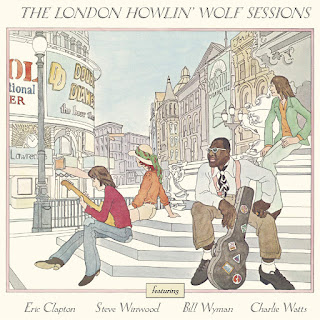
The London Howlin’ Wolf Sessions
For The London Howlin’ Wolf Sessions, Dayron enlisted a band that included the Rolling Stones’ rhythm section of bassist Bill Wyman and drummer Charlie Watts, and guitarist Eric Clapton, who was still flush with fame and fortune from the success of his blues-rock power trio Cream. The producer flew Wolf, his longtime guitarist and musical foil Hubert Sumlin, and young harpslinger Jeffrey Carp to London to record with the British chaps for a week. The sessions weren’t without drama, however – by 1970, Wolf was a sick man, with heart and kidney problems that made the mercurial bluesman even grouchier. Wolf didn’t know what he was doing messing around with these damn fool kids, and some of his performances were tentative, at best.
However, as music journalist and blues historian Bill Dahl outlines in his excellent liner notes to the deluxe edition of The London Howlin’ Wolf Sessions, eventually everything began to gel in the studio and Wolf and the assembled band knocked out an acceptable, if not remarkable album of classic blues music. As a kid I was enchanted by both Howlin’ Wolf and The London Howlin’ Wolf Sessions, one of the first blues albums I’d heard at the time. I had no idea in 1971 or 1972, when I first picked up the album, that blues purists had dismissed it as a trivial work on the part of those involved; or that Clapton had virtually disowned the album (perhaps “Slowhand” should be so frank in reconsidering much of his mediocre 1980s work!).
Built For Comfort
For a fourteen-year-old budding blues fan, however, everything from the painted cover art to the B&W session photos inside, not to mention the music found on The London Howlin’ Wolf Sessions, all came as a revelation that would lead to a deeper study of the blues. Through the years, the initial harsh critical reception afforded the album would soften somewhat, and I’ve since spoken with many musicians that revere these performances. So, some 40 years after its recording, how does The London Howlin’ Wolf Sessions stand up to the master’s body of work?
The album holds up better than might be expected, and maybe even moves up a notch or two towards minor classic status in my estimation. Sure, nothing here is going to match the Wolf’s powerful mid-1950s work for Chess Records, or even his earlier recordings for Sam Phillips in the Sun Studio in Memphis; then again, nothing ever could. Truth is, as the Wolf’s early-to-mid-1960s “albums” were really nothing more than collections of previous singles releases, he wasn’t really an album-oriented artist like Waters would become. Later attempts to appeal to young, album-oriented blues-rock fans with releases like 1969’s This Is Howlin’ Wolf’s New Album or 1971’s Message To the Young would fail miserably commercially and critically. That leaves us with The London Howlin’ Wolf Sessions, a spirited collection of new performances of old songs, delivered with a fresh perspective on the blues while retaining their traditional appeal.
Sittin’ On Top of the World
The London Howlin’ Wolf Sessions leads off with the spry, slightly funky Wolf original “Rockin’ Daddy,” the performance fueled by Sumlin’s loping fretwork and Clapton’s Southern-fried licks. Wolf roars and bellows like the artist of yore, while Phil Upchurch’s (later overdubbed) bass line plays nicely off of Charlie Watt’s timekeeping. Willie Dixon’s classic “I Ain’t Superstitious” is afforded a lush, busy mix with Wolf’s rote vocals nearly lost amidst a wash of overdubbed horns. Clapton’s fretwork here is nuanced and imaginative, if buried in the din, while Ringo Starr’s drums (the musician credited as “Ritchie” on the original album) rise above the otherwise messy mix.
It’s with “Sittin’ On Top of the World” that the album really begins to cook, with Jeffrey Carp’s greasy harpwork sizzling beneath Wolf’s languid vocals; Lafayette Leake’s later overdubbed piano play tinkling in the background as Sumlin’s solid rhythm guitar serves as a foundation on top of which Clapton lets fly with an elegant, undeniably bluesy solo. The rollicking “Worried About My Baby” also makes good use of Carp’s harp, his blasts of harmonica reminding of Junior Wells as Wolf belts out the lyrics above Leake’s lively piano. Wolf’s classic cover of James Oden’s “What A Woman!” (a/k/a “Commit A Crime”) is the most traditional Chicago blues number on the album, the song’s distinctive hypnotic rhythm punctuated by Clapton’s short, shocking leads and a fine, blustery Wolf vocal turn.
The Red Rooster
Another Dixon gem, “Built For Comfort,” was tailor-made for Wolf, and he walks his way through the lyrics with a familiar swagger as the horns flare brightly behind him and Ian Stewart’s intricate piano play is matched by Clapton’s intermittent solos. As Dahl recounts in the album’s liner notes, it was the recording of “The Red Rooster,” with Clapton asking Wolf to show him how to play the song, which would break up the tension of the sessions. While critics like Cub Koda have expressed their dislike of the studio dialog that serves as an intro to the song, it’s intriguing to hear at this late date, and by the time the full band roars into the actual song, everybody is rockin’ full-tilt, from Clapton’s fluid riffing to Wolf’s sly vocals to Leake’s trilling piano.
Although Dixon’s “Do the Do” sounds an awful lot like a Bo Diddley song with its familiar beat, it’s all Wolf, baby, the singer slipping into the fat groove with a fine vocal performance that is itself enveloped by Wyman and Watt’s gorgeous lockstep rhythms and Clapton’s rattletrap fretwork. “Highway 49” rocks hard, with a strong Wolf vocal bolstered by Clapton’s innovative leads, Sumlin’s bedrock rhythms, and Steve Winwood’s lofty piano-pounding, which was dubbed in later. The original album ended with a spirited take of “Wang Dang Doodle,” the song’s mesmerizing rhythms captured perfectly by the band, the slightly-echoed production adding to the song’s exotic vibe, Carp’s harmonica creeping in on the fringes as Stewart’s energetic piano notes dance in the background.
Rockin’ Daddy
This 2012 “deluxe edition” of The London Howlin’ Wolf Sessions includes three bonus tracks at the end of the first disc, performances originally released in 1974 as London Revisited. Of the trio, Wolf’s “Killing Floor” stands out, the song’s sparse arrangement and familiar rhythm complimented by a fair Wolf vocal performance, and some intricate interplay between Wolf and Clapton on guitar. This set also includes a second disc of alternate takes from the London sessions, some varying only slightly from the released version, some drastically so. For instance, an alternative “What A Woman!” includes Winwood’s overdubbed organ, which adds to the general cacophony but does little to enhance the performance.
By contrast, a sparse rehearsal take of “Worried About My Baby,” features Wolf on harmonica, Clapton’s subtle guitar fills, and Wyman’s throbbing bass, the performance displaying a different possibility for the song. The alternate “I Ain’t Superstitious” sounds even funkier than that used on the original album, bassist Klaus Voorman and drummer Ringo Starr doing a fine job on the rhythm while Carp adds some inspired harpwork, but Wolf’s vocals slight and unsatisfying. An extended version of “Do the Do” stretches the song into a bona fide blues jam with Clapton and Stewart in particular playing above the locomotive rhythm. Wolf’s original “Poor Boy” is provided different lyrics and instrumental mix, but Wolf’s vocals still shine brightly amidst the claustrophobic arrangement which is busy with Clapton’s wiry guitar and Carp’s emotional harpwork.
The Reverend’s Bottom Line
A lot of blues have passed through these ears since I first heard The London Howlin’ Wolf Sessions as a teen. While I’d like to think that my musical tastes have expanded and grown more sophisticated through the years, the comfort of the familiar relics of our early years grows larger in our minds. Even when viewed apart from the prism of sentimentality, this most-maligned of albums from the great Howlin’ Wolf’s career sounds better than its most vocal critics dare to admit.
In retrospect, The London Howlin’ Wolf Sessions was a successful experiment that captured the great Howlin’ Wolf during the waning days of his strength and power, the elder bluesman still providing many of his performances with a brittle ferocity. Hubert Sumlin, the rock upon which Wolf’s legacy was built, provides the singer with a familiar face and shared history, while the British players – especially Clapton, who has seldom played better than he does here – infuse the performances with energy and zealous enthusiasm. In short, The London Howlin’ Wolf Sessions stands up well to re-inspection, outliving decades of unfair criticism to achieve classic status on its own numerous merits. (Chess Records, released 1971, reissued August 31, 2012)
Buy the CD from Amazon: The London Howlin’ Wolf Sessions


