Once upon a time, rock ‘n’ roll fanatics had to learn about new album releases
through label advertising in rags like Creem, Trouser Press, Rolling Stone,
Zoo World, Phonograph Record, Bomp! and other music zines of the 1970s and
afterwards. There was no internet and no social media to hype new tunes from
your favorite artists. These ads could be inane, they could be insulting, and
they could be inept but when they were good, they featured a level of artistry
on par with an album's carefully-crafted cover art.
With this third
volume of Fossils, award-winning rock critic and music historian Rev. Keith A.
Gordon peers through the looking glass into the past and these “classic rock
relics,” reconsidering vintage album ads from the 1970s and ‘80s. Offering
insightful and informative commentary on 76 more ads along with images of
each, the “Reverend of Rock ‘n’ Roll” explores this often overlooked creative
aspect of the classic rock era and makes the case for album advertising as art
with its own merits and history.
Rev. Keith A. Gordon has been
writing about rock and blues music for over 50 years for over 100 print
publications and websites worldwide, including Creem magazine, Rock ‘n’ Roll
Globe, High Times, Blurt magazine, Book & Film Globe, the East Village
Eye, Perfect Sound Forever, Blues Music magazine, and The Blues (U.K.).
Fossils v3 is a 164pp 5.5” x 8.5” paperback
with B&W photos and is only available in paperback at $16.95 with shipping
(no eBook version of this one, kids!). Get your copy through the handy
Amazon.com link below or buy an autographed copy direct from Excitable
Press:
Fossils, Relics of the Classic Rock Era, Volume Three
Buy an autographed copy direct from Excitable
Press (PayPal):
Showing posts with label Fossils. Show all posts
Sunday, February 1, 2026
Sunday, September 1, 2019
New Book: Fossils, Relics of the Classic Rock Era v2
Back in the day, record labels didn’t have a network of blogs, artist
websites, and social media to help market new music. They only had FM
radio, cash ‘payola’ to DJs and, if the budget allowed, advertisements
in a handful of music rags like Creem, Trouser Press, and Rolling Stone
to help provide hype for a new release. Much like album cover artwork,
advertisements created for new album releases were often works of art in
themselves.
Creative record label graphic designers often came up with ads that cleverly promoted the artist and their work; just as often, corporate hacks cranked out copy with little or no relation to the album being promoted. With this second volume of Fossils, award-winning rock critic and music historian Rev. Keith A. Gordon takes another look at these “relics,” album advertisements found in frayed and graying copies of cherished old music magazines. Offering insightful and informative commentary on over 60 ads, the ‘Reverend of Rock ‘n’ Roll’ explores this overlooked artistic aspect of the classic rock era.
The “Reverend of Rock ‘n’ Roll,” Rev. Keith A. Gordon has been writing about music for almost 50 years. A former contributor to the All Music Guide books and website, and the former Blues Expert for About.com, Rev. Gordon has also written for Blurt magazine, Creem, High Times, and The Blues (U.K.), among many other publications, and has written two-dozen previous music-related books, including Blues Deluxe: The Joe Bonamassa Buying Guide, The Other Side of Nashville, and Scorched Earth: A Jason & the Scorchers Scrapbook.
Fossils v2 is a 140pp 5.5” x 8.5” paperback with B&W photos and is only available in paperback at $11.95 (no eBook version of this one, kids!). Get your copy through the handy Amazon.com link below or buy an autographed copy direct from Excitable Press:
Fossils, Relics of the Classic Rock Era, Volume Two: The 1960s-'80s
Buy an autographed copy direct from Excitable Press ($11.95 postpaid, PayPal):
Creative record label graphic designers often came up with ads that cleverly promoted the artist and their work; just as often, corporate hacks cranked out copy with little or no relation to the album being promoted. With this second volume of Fossils, award-winning rock critic and music historian Rev. Keith A. Gordon takes another look at these “relics,” album advertisements found in frayed and graying copies of cherished old music magazines. Offering insightful and informative commentary on over 60 ads, the ‘Reverend of Rock ‘n’ Roll’ explores this overlooked artistic aspect of the classic rock era.
The “Reverend of Rock ‘n’ Roll,” Rev. Keith A. Gordon has been writing about music for almost 50 years. A former contributor to the All Music Guide books and website, and the former Blues Expert for About.com, Rev. Gordon has also written for Blurt magazine, Creem, High Times, and The Blues (U.K.), among many other publications, and has written two-dozen previous music-related books, including Blues Deluxe: The Joe Bonamassa Buying Guide, The Other Side of Nashville, and Scorched Earth: A Jason & the Scorchers Scrapbook.
Fossils v2 is a 140pp 5.5” x 8.5” paperback with B&W photos and is only available in paperback at $11.95 (no eBook version of this one, kids!). Get your copy through the handy Amazon.com link below or buy an autographed copy direct from Excitable Press:
Fossils, Relics of the Classic Rock Era, Volume Two: The 1960s-'80s
Buy an autographed copy direct from Excitable Press ($11.95 postpaid, PayPal):
Saturday, January 7, 2017
Fossils, Volume One now available!
Maybe you’ve read one of the Reverend’s “Fossils” pieces here on That Devil Music; it’s been a popular feature hereabouts for a couple years. Back in the day, record labels didn’t have a network of blogs, artist websites, and social media to help market and promote new music. They only had FM radio, cash ‘payola’ to DJs and, if the budget allowed, advertisements in a handful of music rags like Creem, Trouser Press, and Rolling Stone to help provide hype for a album new release.
Much like album cover artwork, advertisements created for new album releases during the ‘70s were often works of art in themselves. Creative record label graphic designers often came up with ads that cleverly promoted the artist and their work; just as often, corporate hacks cranked out copy with little or no relation to the album being promoted. With the “Fossils” posts, I looked at these “classic rock relics,” album ads found in frayed and graying copies of cherished old music magazines.
The Reverend’s Fossils, Volume One: The '70s book is now available in paperback for the low, low one-time fee of $9.95, and if you order direct, I’ll even autograph your copy (U.S. orders only, please). Offering insightful and informative commentary on this often overlooked aspect of the classic rock era, the Rev took the 20 or so “Fossils” posts from That Devil Music and wrote a whole bunch more of ‘em…over four-dozen ads total in a 5.5”x8.5” trade paperback that runs 100 pages with high-rez scans of each advertisement.
Get your copy from Amazon.com or direct from the publisher, Excitable Press (PayPal link below).
Buy the book from Amazon.com
Buy the book from Excitable Press (via PayPal, U.S. orders only):
Much like album cover artwork, advertisements created for new album releases during the ‘70s were often works of art in themselves. Creative record label graphic designers often came up with ads that cleverly promoted the artist and their work; just as often, corporate hacks cranked out copy with little or no relation to the album being promoted. With the “Fossils” posts, I looked at these “classic rock relics,” album ads found in frayed and graying copies of cherished old music magazines.
The Reverend’s Fossils, Volume One: The '70s book is now available in paperback for the low, low one-time fee of $9.95, and if you order direct, I’ll even autograph your copy (U.S. orders only, please). Offering insightful and informative commentary on this often overlooked aspect of the classic rock era, the Rev took the 20 or so “Fossils” posts from That Devil Music and wrote a whole bunch more of ‘em…over four-dozen ads total in a 5.5”x8.5” trade paperback that runs 100 pages with high-rez scans of each advertisement.
Get your copy from Amazon.com or direct from the publisher, Excitable Press (PayPal link below).
Buy the book from Amazon.com
Buy the book from Excitable Press (via PayPal, U.S. orders only):
Saturday, August 13, 2016
Fossils: Sire Records’ Don’t Call It Punk
| [click to embiggen] |
Even after being swallowed whole by Warner Brothers Records in 1978, Stein ensured that Sire Records continued to sign a diverse range of artists, the label finding overwhelming mainstream success with acts like Madonna and the Pretenders, but also launching the careers of artists like the Flamin’ Groovies, the Cure, the Smiths, and the Replacements. Sire was also an early player in rap music, releasing a handful of mid-to-late ‘80s era albums by Ice T.
This “Don’t Call It Punk” advertisement from a 1977 issue of Trouser Press magazine is curiously and uncharacteristically tone-deaf for such a forward-thinking and progressive record label. Buying into the industry’s overall attempt to whitewash punk rock by re-labeling it as “new wave,” Sire went all-in by trying to hype its hot new albums – now-classic discs by Richard Hell & the Voidoids, Talking Heads, the Dead Boys, and the Saints – as the best of the “new wave,” working hard to smooth the punk genre’s rough edges and make it more commercially acceptable.
Three of the four albums featured are unabashedly punk in nature, and while I think that the ad’s general lay-out and use of copy is effective, the label’s futile attempt downplaying what made these albums attractive to young listeners in the first place is laughable in light of the fact that three of these four discs have since become known as milestones of punk rock. So it goes...
Sunday, July 10, 2016
Fossils: Ralph Records – Musick For Weirdos (1978)
| [click to embiggen] |
Not so much an advertisement for a single album release but rather a clever slab o’ bloato-hype from avant-garde indie label Ralph Records for a slew of their releases. Formed in 1972 in San Francisco by cult rockers the Residents when they realized that no corporate label would come anywhere near the band without a hazmat suit and ten-foot-pole, Ralph’s first album release came in 1974 with the extraordinary Meet The Residents, as bizarre-o a chunk of PVC as one would ever slap on a turntable. After their acclaimed debut, Residents’ albums fell like acid rain on the fringes of American rock ‘n’ roll, beginning with 1976’s The Third Reich ‘n Roll and following with 1977’s Fingerprince, 1978’s Not Available and the oddball Duck Stab!/Buster & Glen, a compilation of the band’s seven-song Duck Stab! EP on the A-side and Buster & Glen holding down the B-side of the album.
The Residents evidently attracted a lot of like-minded fellow-travelers, and Ralph Records began releasing 45rpm singles and full-length albums by a number of, ah…shall we say ‘unique’ artists who fell into orbit around the label. The first was guitarist Philip “Snakefinger” Lithman, whose 7” single “The Spot” was release by Ralph in 1978, followed by a wonderful full-length album the next year, Chewing Hides The Sound featuring songwriting and musical contributions by the Residents as well as covers of Kraftwerk’s “The Model” and composer Ennio Morricone’s “Magic and Ecstasy,” from the soundtrack of the movie Exorcist II: The Heretic. Of Snakefinger’s debut LP, the All Music Guide’s Tom Schulte says “this is the peculiar and unique material of a cult guitarist extraordinaire. Each song is a quirky island in a sea of sonic oddity.”
Snakefinger would record five albums total for Ralph Records, as well as a number of singles and appearances on several of the Residents’ albums. The label would go on to release and promote music from a number of original, singular artists during the 1980s and ‘90s, including Fred Frith, Voice Farm, Tuxedomoon, MX-80 Sound, Renaldo and the Loaf, and the ‘King’ of the American underground, Eugene Chadbourne. This advertisement, culled from an old issue of Trouser Press – perhaps the only music zine to pay attention to Ralph Records and its bastard children at the time – is a striking and effective way to promote the label’s releases, displaying cover shots of several singles/EPs along with the label’s recognizable logo. An almost subliminal phrase “you will buy lots of Ralph Records” is repeated in the background, and the label’s address on the side encourages the curious to send off for a catalog…an important bit of marketing that seems quaint in the Internet era...
Saturday, February 27, 2016
Fossils: Felix Pappalardi & Creation (1976)
| [click to embiggen] |
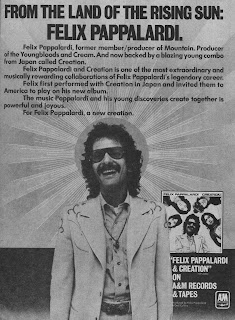
Pappalardi, a classically-trained musician, would become best-known for his role as bass player and producer of one of the heaviest dinosaur-rock outfits that would stomp across the planet in Mountain. Pappalardi had previously worked in the studio with guitarist Leslie West’s band the Vagrants, and when Cream broke up, ol’ Felix saw an opportunity for a like-minded power trio. Enlisting the larger-than-life guitarist and vocalist to front Mountain, the band’s first two albums would go Gold™ in the U.S. and result in a classic rock radio staple in the song “Mississippi Queen.” When Mountain broke-up, Pappalardi semi-retired from touring due to rock ‘n’ roll-induced partial deafness; he later returned to the studio to produce records by the Flock, Hot Tuna, and even punk rock legends the Dead Boys.
In 1976, Pappalardi hooked up with Japanese hard rockers Creation, who had opened for Mountain during the band’s earlier tour of Japan, for a one-off record titled Felix Pappalardi & Creation. They benefited from a high-profile tour, opening for Bob Seger and Kiss, but lacking the charismatic presence of the larger-than-life West, the album went nowhere fast. The label’s ad for Felix Pappalardi & Creation was certainly grand enough, the bass player standing front and center with a rising sun behind him, his head haloed by rays of light. It plays up his impressive bona fides, but it may have been too little, too late. Pappalardi would make his proper solo debut with 1979’s Don’t Worry, Ma collection of covers. Tragically, a Mountain reunion would later occur without the accomplished bassist, as Pappalardi was shot to death in 1983 by his songwriter wife Gail Collins.
Saturday, February 6, 2016
Fossils: MC5's Back In The USA (1970)
| [click to embiggen] |
But MC5 were no ordinary band, and their deep repertoire of original material and inspired covers of deep blues, soul, and jazz sides allowed them to introduce themselves with a high-octane live collection that would hit #30 on the charts on the strength of its incendiary title track. Back In The USA was a different kind of beast, however – produced by rock critic Jon Landau (who would later become Bruce Springsteen’s manager), the album masterfully blended punkish intensity with a raucous, melodic power-pop sound that would yield some of the band’s best original songs in “Teenage Lust,” “High School,” and “Shakin’ Street,” songs that would in turn influence bands like the Dictators, the Flamin’ Groovies, and the New York Dolls, among others.
Atlantic’s ad campaign for Back In The USA was simple – a black and white photo of the band, clad in leather jackets with a collective sneer on their faces, looking like a gang of ruffians (an image later appropriated to good use by the Ramones). Beneath the dominant band photo is a list of the album’s songs, and a shot of the cover. Although Back In The USA found nowhere near the success of its predecessor, rising only as high as #137 on the charts, its influence would cross the decades. It has since become considered a high water mark for the legendary band, and you can hear strains of MC5 in the music of the White Stripes, the Clash, the Dead Kennedys, Radio Birdman, and other bands across the spectrum of the rock, punk, and metal genres.
Friday, January 29, 2016
Fossils: Led Zeppelin's Houses of the Holy (1973)
| [click to embiggen] |
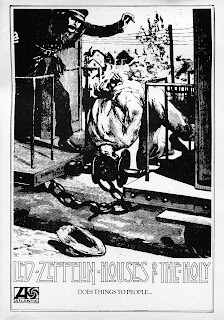
The album was not without its own controversy, however – the imaginative cover art, created by Aubrey Powell of Hipgnosis, features a number of apparently naked children crawling across the stones of some ancient, arcane temple. Some retailers, especially in the Southern U.S. states, refused to stock the album because of its cover (relax, people – the kids were wearing body suits). Like its predecessor, neither the album’s title nor the band name adorned the cover of Houses of the Holy, although a paper wrapper with the info was strategically-strapped around the cover to block out the horribly naked (and oddly colored) children.
Also like Led Zeppelin’s fourth effort, fans promptly figured out the ruse, and Houses of the Holy would eventually move better than ten million copies worldwide, topping the charts in the United States, Canada, Australia, and the U.K. The print advertising for Houses of the Holy eschewed the album’s brilliant cover artwork in favor of cool Victorian-era styled B&W pen-and-ink art that showed a bound man’s head being squeezed in a viselike contraption between two railway cars. A simple tagline beneath the album’s title read “does things to people…” For Zep’s legion of rabid, cash-toting fans, nothing else needed to be said…
Sunday, December 27, 2015
Fossils: Kraftwerk's Radio-Activity (1975)
| [click to embiggen] |
German electronic music pioneers Kraftwerk enjoyed an unexpected level of success when the band’s fourth album, 1974’s Autobahn, scored a surprising Top 30 chart hit with its title track. The popularity of “Autobahn,” cut down from the album length of 22+ minutes to a mere 3:27 for radio airplay, pushed the album itself to number five on the Billboard chart. It would be the band’s lone U.S. hit, and although they would continue to make music well into the 1980s, they’d never again achieve this level of commercial success stateside.
The band’s modest achievement didn’t go to their collective heads, as shown by the 1975 release of Kraftwerk’s Radio-Activity album. A return to the more electronically-oriented noise-making of their earlier work, the album’s conceptual aesthetic – exploring the subject of radio waves and outer space – was bolstered by scraps of bleeping sound, silent passages, raucous noise, and overall electronic weirdness. The album’s lone concession to commercial reality came in the form of Kraftwerk’s first English language song in the title track. While garnering critical accolades, the album’s lone single (the title track) stiffed badly, and Radio-Activity only rose as high as #140 on the charts.
Capitol Records really had no idea what to do with Kraftwerk or Radio-Activity, but the simple B&W ad created for the album was oddly effective. Utilizing the simple black box from the album cover, they tacked on a photo of the band in a frame on top. For Krautrock fans, this was more than enough as the announcement of a new Kraftwerk LP was cause for rejoice in certain circles. The band would find a modicum of success with subsequent albums like Trans-Europe Express (1977) and Computer World (1981), especially when their electronic tunes were adapted to 1980s dance culture. Kraftwerk’s influence would be wide-ranging, their musical innovations touching such disparate genres as hip-hop, EDM, keyboards-dominated new wave, and avant-garde composition.
Wednesday, December 16, 2015
Fossils: Kiss “Spirit of ‘76” (Destroyer tour)
| [click to embiggen] |
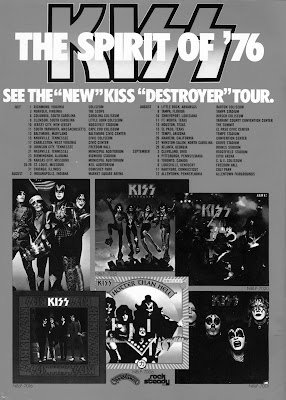
Hard rock legends Kiss were riding high by the time of the American bicentennial. The band’s 1975 live double album Alive! was their highest-charting album to date (#9), earning Gold™ Record status for 500,000+ in sales (no mean feat in the mid-1970s). Their much-anticipated fourth studio album, Destroyer, was released in March 1976 to mixed reviews. Working for the first time with producer Bob Ezrin (Alice Cooper, Lou Reed), the band expanded its sonic palette beyond the simple hard rock of its earlier efforts, a move rejected and/or ridiculed by critics.
The album sold rapidly on the basis of its predecessor’s success, going Gold™ in a month and peaking at #11 on the charts before seemingly topping out at slightly more than 800,000 copies sold. When deejays began playing “Beth,” the B-side of the album’s under-performing third single, “Detroit Rock City,” it reignited the album’s fortunes, “Beth” rising to #7 on the singles chart and pushing the album to double Platinum™ sales. The album’s initial stumble would be redeemed over the band’s lengthy career, with Destroyer becoming known as an influential hard rock/heavy metal effort on the basis of songs like “Detroit Rock City,” “Shout It Out Loud,” and “King of the Night Time World.”
Rather than hype Destroyer on its own, the band’s label – Casablanca Records – chose instead to promote the band’s 1976 tour with opening act Bob Seger with this generic tour dates ad with just a passing nod to Destroyer and the band’s previous albums. Then again, Casablanca didn’t have much faith in the band’s future after the success of Alive! (which made the label a truckload of cash), re-signing them to a two-album deal rather than taking a flyer on their future efforts. The album’s eventual blockbuster status belies Casablanca’s non-committal advertising, and Kiss would part ways with Seger after just a handful of shows during which the Motor City rocker blew the headliners off the stage night after night with a superior (and rockin’) performances.
Sunday, December 6, 2015
Fossils: Jo Jo Gunne's Bite Down Hard (1973)
| [click to embiggen] |
Boogie rockers Jo Jo Gunne were formed in 1971 by former Spirit members Jay Ferguson (vocals) and Mark Andes (bass), with Mark’s brother Matt (guitar) and Curly Smith (drums) rounding out the line-up. The band’s self-titled 1972 debut scored a Top 30 U.S. hit with the single “Run Run Run” (Top 10 in the U.K.), the album itself hitting a respectable #57 on the U.S. charts. Mark Andes fell out with his brother and Ferguson after the debut album’s release and left the band for a stint with Firefall before hooking up with Heart for an extended run.
Undaunted, Jo Jo Gunne brought in new bassist Jimmie Randall, who would stay with the band through its bloody end, and they rushed into the studio to record a follow-up to their debut in order to capitalize on its relative success. Bite Down Hard was the result, a similarly boogie-based high-octane set that nevertheless sounds rushed, tired, and repetitive. There was too much of the same raucous vibe that fueled the debut, but no single song popped and crackled like “Run Run Run” and, lacking an obvious hit single, the album struggled to hit #75 on the charts.
Asylum Records certainly supplied an eye-catching advertisement to push the new album, even if it did little to improve the band’s diminishing fortunes. Featuring a pair of cartoon teeth chomping down on a bullet and the tagline “music you can really get your teeth into,” it’s an irreverent attempt to introduce rock fans to Bite Down Hard while making a cheeky play on the album’s title.
The band’s third album in two years, Jumpin’ The Gunne, was essential a Jay Ferguson solo album and would be saddled with atrocious cover artwork that did nothing to help it barely squirm its way onto the charts (peaking at #169). Matt Andes left after this third album, to be replaced by John Staehley, another Spirit alumnus. One more LP would emerge – 1974’s So…Where’s The Show – which would be the band’s hardest rocking and most consistent album. It was a case of too little, too late, however as Jo Jo Gunne burned out from too much touring, too many records, and only one hit song to show for their work.
Sunday, November 22, 2015
Fossils: Johnny Winter's Still Alive & Well (1973)
| [click to embiggen] |
After the release of the Johnny Winter And album in 1970, blues-rock guitarist Johnny Winter retreated from the music biz to seek treatment for his increasingly debilitating heroin addiction. During the interim, his brother Edgar scored big with his They Only Come Out At Night album and its hit single “Frankenstein.” A common refrain during Edgar’s 1972 tour was “hey man, where’s your brother?”
The elder Winter brother came roaring back in 1973 with his fifth studio album, Still Alive & Well, the album title both an answer to the question on everybody’s mind as well as a statement of purpose. Working with his former bandmates Rick Derringer and Randy Jo Hobbs, Winter delivered a high-energy set of blues and roots-rock that included a handful of original songs by Winter and Derringer as well as classic covers like Big Bill Broonzy’s “Rock Me Baby” and the Rolling Stones’ “Let It Bleed.” The Stones also contributed a new song, “Silver Train,” for Winter to spin his magic on, and Winter’s original “Too Much Seconal” is a bluesy, personal warning about drug abuse. Derringer’s “Cheap Tequila” is a fine twangy roots-rocker while the title track is a defiant musical statement tailor-made for Winter’s slash ‘n’ burn fretwork.
Still Alive & Well performed admirably in spite of Columbia Records’ bland advertising efforts. This ad for the album is little more than a photo outtake from the session that provided the cover artwork. Displaying, perhaps, Winter’s undeniable albino chic, it says little of the guitarist’s return after three years or his impressive and expanding musical palette. The album peaked at #22 on the Billboard magazine album chart anyway, Winter’s fans obviously excited about the guitarist’s much-anticipated return.
Sunday, November 8, 2015
Fossils: Jimmy Buffett's A1A (1974)
| [click to embiggen] |
A1A, the fourth album from Jimmy Buffett, was a transitional work in every sense of the word. Buffett had spent better than half a decade in the trenches of Nashville trying to make it as a country singer and songwriter, playing dives like Sam’s Pizza Place and pitching tunes to publishers on Music Row. Buffett’s third ABC Dunhill album, 1974’s Living and Dying in 3/4 Time, scored a minor pop and country hit in “Come Monday,” an effective mid-tempo soft rocker closer in spirit to California-based Avocado Mafia songwriters like Jackson Browne or David Crosby as opposed to the new brand of Texas-bred cosmic cowboys like Guy Clark or Jerry Jeff Walker.
In the wake of a divorce and re-location to Key West, Florida Buffett began to shed his Music City roots and re-invented himself as a country-rock beach bum. A1A, named for the highway which runs along the Atlantic coast of Florida, mixes autobiographical tunes like “Trying To Reason With Hurricane Season,” “A Pirate Looks at Forty,” and “Life Is Just A Tire Swing” with choice covers like Alex Harvey’s “Makin’ Music For Money” and John Sebastian’s “Stories We Could Tell,” the performances blending country, rock, and the occasional island riddims. Buffett enjoyed a minor country hit with the album’s twangiest track, the humorous “Door Number Three” (#88), while the album itself struck a chord with mainstream audiences, A1A becoming the singer’s highest-charting LP to date (#25).
The ABC Dunhill ad for A1A wasn’t particularly effective or gripping, the giant head of Jimmy Buffett hovering, godlike, above a sand-coursed stretch of highway. The ad copy says little of the album save for an attempt to make a Nashville connection for the music – not the best way, perhaps, to sell the singer’s new creative direction, but then again, ABC didn’t have the spare cash to spread around and hype the album at the time. It didn’t matter, really, ‘cause Buffett had clearly found his preferred musical blueprint and, after his tiny label was absorbed by the multinational MCA Records, he’d hit the big time three years later with his signature song “Margaritaville,” the perfect distillation of his beach bum troubadour persona which would hit Top 20 on both the pop and country charts.
Sunday, November 1, 2015
Fossils: Jefferson Starship's Spitfire (1976)
| [click to embiggen] |
What a difference a few years makes – discarding Jefferson Airplane frontman Paul Kanter’s solo debut Blows Against The Empire, which was credited to Kanter and “Jefferson Starship,” and was more of a hard rock hippie fever dream than a pop album – by 1974, the Airplane had been grounded. The band added new guitarist Craig Chaquico and bassist Pete Sears (to replace founding members Jorma Kaukonen and Jack Casady, who went full-time with their Hot Tuna side project) and took flight anew as Jefferson Starship. The 1974 release of Starship’s Dragon Fly hit #11 on the charts, but the following year’s Red Octopus rose to the top spot on the strength of the hit single “Miracles.”
Starship’s third album as a full band, 1976’s Spitfire, couldn’t boast of material of the strength of “Miracles,” but it rode high on the charts nonetheless, sitting at #3 for three weeks and eventually selling better than a million copies. The album’s colorful cover artwork was certainly striking, the brilliant graphics making for a memorable ad that featured an enigmatic female figure astride an Asian styled dragon and, at the bottom, the album’s name. Although the label stepped up its game for the album artwork, the ad itself is pretty lazy, saying nothing about the band or music and relying instead on the LP imagery itself to sell the product.
Friday, October 16, 2015
Fossils: Jefferson Airplane's Volunteers (1972)
| [click to embiggen] |
Released during the dimming days of the “peace & love” decade of the 1960s, the Jefferson Airplane’s Volunteers was, arguably, both one of their best albums and one of their most controversial. The band’s leftist, anti-war politics shone brightly in the lyrics of songs like “We Can Be Together” (in which the label tried to censor the word “motherfucker) and the title track while songs like “Good Shepherd” and “Eskimo Blue Day” evinced more of a “back to the land” Earth goddess vibe. Musically, Volunteers ranged from hippie folk and psychedelia to anthemic hard rock.
The album extended the band’s string of five straight Top 20 albums, peaking at #13 on the Billboard Top 200 while the title track rose to #65, quite an accomplishment for a politically-charged song at the dawn of the AOR era. The label’s ad for the album certainly didn’t help its commercial prospects – I’m sure that the band’s high-profile performance at the Woodstock festival a few months previous did more for Volunteers – the ad’s graphic showing little more than a photo of the LP cover, the band’s name in too-large type, and an out-of-the-place copy of Dan O’Neill’s “Odd Bodkins” comic.
Volunteers would be the last album from what is considered to be the band’s classic line-up, drummer Spencer Dryden forced out and replaced by Joey Covington. Singer Marty Balin would also leave soon thereafter, and before the 1971 release of Bark, the band’s sixth Top 20 LP in a row and the first for its RCA-distributed Grunt Records vanity label. Considering how little effort or thought went into the ad design for Volunteers, or even the album cover artwork of Bark, it’s not sure if the band was too stoned to realize that they were being dissed by the label.
Sunday, October 4, 2015
Fossils: Iggy and the Stooges' Raw Power (1973)
| [click to embiggen] |
The early 1970s was a tumultuous time for Iggy Pop and the (Psychedelic) Stooges. While the band had released a pair of critically-acclaimed albums in The Stooges (1969) and Fun House (1970) that would eventually become two of the most influential and iconic albums in rock music history. Both albums were deemed commercial busts, though, and the band couldn’t get arrested even in their Motor City hometown. As the various members drifted into hardcore substance abuse, Iggy tried to keep the band afloat by juggling the line-up and adding underrated guitarist James Williamson, but it looked as if the Stooges were about to become mere rock ‘n’ roll footnotes when an unexpected savior stepped in to put the band on the road to immortality.
A chance meeting in 1972 between Iggy Pop and David Bowie would lead to the British glam-rock star taking the wheel of the badly listing Stooges ship of state and, temporarily at least, setting the band on a straight course. Bowie’s manager took on the band, and the singer – who was at the height of his Ziggy Stardust era fame – took the band into the studio to record their important, groundbreaking third album. Released in 1973, Raw Power would ultimately provide a template for young punks around the world to follow just a couple years later, and songs like “Search and Destroy,” “Gimme Danger,” “Your Pretty Face Is Going To Hell,” and the high-octane title track would inspire a several subsequent generations of young, loud, and snotty rockers.
The Columbia Records ad for the album featured the iconic photo of a young Iggy Stooge strangling the microphone alongside influential quotes from Creem magazine’s Dave Marsh and Rolling Stone’s Lenny Kaye (future Patti Smith Band guitarist)…simple, but effective, conveying both the band’s sense of danger (now billed as “Iggy and the Stooges”) and the energetic nature of the music to be found in the grooves.
Sunday, September 20, 2015
Fossils: Gentle Giant's Octopus (1972)
| [click to embiggen] |
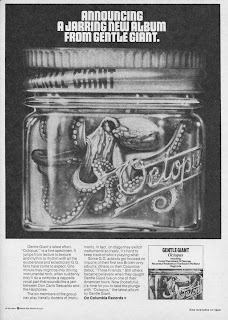
By 1972, British rockers Gentle Giant were firmly entrenched in the mid-tier of progressive rock outfits, a step behind more successful chartbusters like Yes and Emerson, Lake & Palmer and not as highly regarded as critical darlings like King Crimson and Jethro Tull. Instead, they were kind of lumped in together with bands like Starcastle and the Strawbs, esteemed groups that enjoyed pockets of fandom but achieving only a modicum of commercial success. Although Gentle Giant would eventually transcend its cult band status to be considered one of the important and influential movers and shakers of 1970s-era prog-rock, with the release of their fourth album Octopus, they were just looking for a hit.
Although Octopus received uniformly positive reviews, with rockcrit handicappers predicting it to be the band’s breakthrough moment, Columbia Records’ advertising for the album did little to support Gentle Giant’s chart aspirations. Lauded for the virtuoso musicianship displayed by band founders the Shulman brothers (Derek, Phil & Ray), as well as guitarist Gary Green and drummer/multi-instrumentalist Kerry Minnear, the U.S. version* of Octopus sported an intriguing Charles White cover design that portrayed a stylized cephalopod captured in a jar. Columbia’s ad featured Berg’s striking cover front and center and larger than life, tagging it with a horrible pun (“a jarring new album”…really, what were you guys smoking/snorting to come up with a line like that?) and reducing the descriptive text to the fine print at the bottom of the page.
They’d have been better off reducing the size of the dominating graphic (which is reproduced again at the bottom of the ad) and including short, pithy, easy-to-read descriptions of the band and the album instead of the dense text that nobody bothered to dig through. By this time, the band’s fan base was pretty much set in stone, and Octopus only rose to #170 on the Billboard Top 200 before sinking. Although Gentle Giant would call it quits in 1980, they still had a couple of masterpieces up their sleeve and Octopus, along with the following year’s In A Glass House and 1975’s Free Hand would prove to be the cornerstones of the band’s enduring legacy.
* The U.K. version of Octopus featured typically cool Roger Dean cover artwork
Related Content: Gentle Giant's Octopus gets the Steven Wilson Treatment!
Sunday, August 30, 2015
Fossils: The Faces' Ooh La La (1973)
| [click to embiggen] |
In the three years following the Faces’ rise, phoenix-like, from the ashes of British mod-era rockers the Small Faces, it had been a hell of a party. Although albums like 1971’s Long Player and A Nod Is as Good As a Wink…to a Blind Horse are now considered rock ‘n’ roll classics, and both were modest-to-impressive commercial successes (the former hitting #29 on the charts, the latter rising to #6 on the strength of the hit single “Stay With Me”), by the time of 1973’s Ooh La La, frontman Rod Stewart’s solo success had begun to outshine his erstwhile band. Ooh La La would take a step backwards on the charts, rising only as far as #21and yielding no hit singles; by contrast, Stewart’s fourth solo album, the previous year’s Never A Dull Moment, hit #2 on the charts and coughed up a pair of hits.
While it was apparent to anybody at the time that Stewart was sidling, albeit in slow-motion, towards the door on his way to exiting for a full-time solo jaunt, that doesn’t mean that Ooh La La doesn’t have its charms. Rod the Mod may have been gracing magazine covers instead of, say, bandmates Ron Wood or Ian McLagen, but Ooh La La was a true group effort, with all five members involved in the songwriting, resulting in great tunes like “Cindy Incidentally” and “Borstal Boys.” It was bassist Ronnie Lane, one of the original Small Faces, who was the band’s creative heart, and he dominated the songwriting on the album’s second half, providing the Faces with a fitting swansong for their final album.
The Warner Brothers label ad for the album was a perfect portrayal of the band’s public image, the reckless rockers gazing upwards at the upturned skirt of the dancing girl as the album cover’s leering visage sits in the top right corner. When the label called Ooh La La the Faces’ “sauciest album,” they may have been partly kidding, but they also weren’t that far off the mark!
Sunday, August 9, 2015
Fossils: Dwight Twilley Band's Sincerely (1976)
| [click to embiggen] |
Although cult rocker Dwight Twilley scored a Top 20 hit single in the spring of 1975 with the infectious, melodic “I’m On Fire,” he was nevertheless about five years too early for the 1980s power-pop revival he helped inspire and influence. For Twilley and musical partner Phil Seymour, it would take almost a year and a lot of false starts before they’d come up with a proper debut, 1976’s excellent Sincerely album.
Sadly, it seemed to be a case of “too little, too late.” Although Sincerely scratched its way onto the Top 200 chart (peaking at #138), there wouldn’t be another “I’m On Fire” in the offing. The pair built upon a fine pop-rock tradition that included similar cult faves as Crabby Appleton and Big Star, or even moderately-successful bands like Badfinger and the Raspberries, with songs like “Could Be Love,” “Release Me,” and “Baby Let’s Cruise” finding an appreciative, albeit smallish audience that has only increased over the ensuing decades.
Although the band’s label – Leon Russell’s Shelter Records – lacked the financial resources to fully promote Sincerely, the advertising that accompanied the album’s release masterfully evoked a simpler time, calling up the nostalgia of summertime, drive-in movies, and intelligent pop-rock music of the Dwight Twilley Band variety. Twilley has continued to make great music in a similar vein, most recently with 2014’s Always album…but he’ll forever be revered by power-pop fanatics for the groundbreaking Sincerely and it’s follow-up, 1977’s Twilley Don’t Mind.
Sunday, July 26, 2015
Fossils: The Doors' Morrison Hotel (1970)
| [click to embiggen] |
You’d think that with the Doors’ fifth studio album in four years (plus 1970’s live Absolutely Free, the less said about the better…), that Messrs. Morrison and company would begin to run out of musical ideas, but it wasn’t so. Whereas 1969’s The Soft Parade witnessed a band treading water and wondering how to get out of the pool, just a year later Morrison Hotel found a re-energized, raw, and ready-to-rumble outfit revisiting their blues roots (the Texas-flavored “Roadhouse Blues” and “The Spy”); delving into psychedelic mysticism (“Indian Summer,” “Waiting For The Sun”); and diving back into the existential deep end with the dark-hued, malevolent “Peace Frog.”
Although Morrison Hotel yielded no hit singles (tho’ “Peace Frog” grabbed a lot of FM airplay and “Roadhouse Blues” would rise as high as #50 on the singles chart), it was a commercially-successful mix of blues and hard rock (hitting #4 on the album chart) that paved the way for L.A. Woman the following year. Advertising for Morrison Hotel was just more or less a variation on the album cover, but the band photo – taken in some little alcove off some street – displays a certain gritty authenticity that plays well with the music. At this point in their career arc, the Doors really only needed to let fans know that a new album had been released and the rock ‘n’ roll gods would take care of the rest…
Subscribe to:
Posts (Atom)