Sunday, May 31, 2015

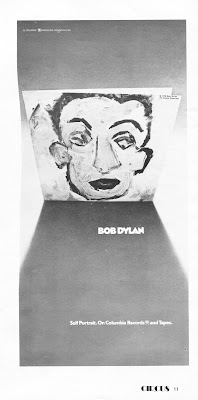
Fossils: Bob Dylan's Self Portrait (1970)

Bob Dylan's Self Portrait
(click to embiggen)
Bob Dylan – Self Portrait

Perhaps the most misunderstood and maligned of Dylan’s early albums, and an inauspicious beginning to the decade of the 1970s (especially after the previous year’s acclaimed, country-flavored Nashville Skyline), Self Portrait isn’t quite the pail of lukewarm dishwater it’s often made out to be. Confusing, yes, even to the sort of prawn that spends their lives trying to suss out the Shakespeare of Rock’s every utterance. With Self Portrait, Dylan was literally providing us with a series of crudely-painted canvases, the singer often applying the broadest of strokes, but revealing glimpses of the face behind the mask with a mix of originals, outtakes, and cover songs that each displayed a facet of Dylan’s temperament at the time…sometimes joking, sometimes playful (like a cat toying with a mouse), never less than thought-provoking.  

Released as a two-album set with Dylan’s original artwork gracing the cover, the two-dozen numbers on Self Portrait run the gamut from influential covers (Boudleaux Bryant’s “Take Me As I Am” and “Take A Message To Mary”); contemporary cover songs (Paul Simon’s “The Boxer,” Gordon Lightfoot’s “Early Morning Rain”); vintage folk tunes (“Days of ‘49”); and old material, including outtakes from The Basement Tapes LP (“The Mighty Quinn,” “Like A Rolling Stone”). Taken altogether, critics at the time considered it a rambling mess unworthy of an artist of Dylan’s stature. I prefer to think of it as a psychic “cleaning out of the closet” that would lead to the undisputedly brilliant New Morning album. Still, Self Portrait has its adherents, as shown by Sony’s decision to release an expanded “deluxe” reissue version of the album in late 2013. 

CD Review: James Burton, Albert Lee, Amos Garrett & David Wilcox's Guitar Heroes (2015)

James Burton, Albert Lee, Amos Garrett & David Wilcox's Guitar Heroes
Unless you’re the kind of geek that pores over album cover notes or (*shudder*) reads Rolling Stone magazine for fun, chances are that you’re not familiar with the men responsible for this recording. The musical pedigrees of the four talented guitarists featured on Guitar Heroes are unassailable, however, each making a major individual contribution to the big book of rock ‘n’ roll…some of these guys were riding up and down the backroads long before string-benders like Eric Clapton and Jimmy Page ever hit the stage.

The oldest of our quartet, James Burton, is a Rock & Roll Hall of Fame inductee who played with Ricky Nelson throughout his teen idol years; he later led Elvis Presley’s band from 1969 until his death in 1977. Burton’s list of album credits is long enough to fill a phone book, but among those he’s played and recorded with are Gram Parsons, Roy Orbison, Elvis Costello, Jerry Lee Lewis, and Johnny Cash. British multi-instrumentalist Albert Lee is no slouch himself, making his bones as part of the legendary Chris Farlowe’s Thunderbirds in the early 1960s before forming the underrated British rock outfit Head Hands & Feet, which released a number of fine albums in the early 1970s.

Burton, Lee, Garrett & Wilcox – Guitar Heroes


Lee was Burton’s replacement in Emmylou Harris’s Hot Band and, aside from his own acclaimed solo work, he has performed and/or recorded with a virtual “who’s who” of 20th century musical giants, including Eric Clapton, Deep Purple’s Jon Lord, Gene Clark of the Byrds, Roseanne Cash, and Bill Wyman’s Rhythm Kings, among many others. So, we have representatives of the USA and Great Britain, how about Canada? Amos Garrett’s contributions are no less impressive than his peers – he toured behind popular Canadian duo Ian & Sylvia in the late 1960s before joining Paul Butterfield’s Better Days with his friend Geoff Muldaur, recording a pair of albums with the Chicago blues legend.

Garrett later played on Maria Maldaur’s hit 1970s-era albums – that’s his guitar you’ll hear on Maldaur’s “Midnight at the Oasis” – and has enjoyed his own acclaimed solo career as well as playing alongside folks like Jerry Garcia, Elvin Bishop, Stevie Wonder, and Todd Rundgren. Fellow Canadian David Wilcox, at 65 years old, is the kid in this guitar-wielding gang. Although not as well-known as his older colleagues, Wilcox has forged a lengthy and successful solo career in his homeland and, like Garrett, is an alumnus of Ian & Sylvia’s beloved Great Speckled Bird band.

Masters of the Telecaster


Backed by Albert Lee’s regular touring band, including keyboardist and vocalist Jon Greathouse, bassist Will MacGregor, and drummer Jason Harrison Smith, these four “Masters of the Telecaster” came together for a special one-night performance at the Vancouver Island MusicFest in July 2013. Guitar Heroes captures that concert exactly as it happened, with no editing, overdubs, or studio gimmicks – just four old road warriors pickin’ together on an inspired set of blues, rockabilly, and rock ‘n’ roll tunes. If you’re the kind of music-lovin’ fool that likes to hear some fancy guitarplay, then Guitar Heroes is right up your alley…

Guitar Heroes opens with a rockabilly rave-up of Elvis’s cover of Arthur “Big Boy” Crudup’s juke-joint jam “That All Right (Mama),” a song probably performed ad nauseum by Burton back in the ‘70s. With Garrett handling the vocals, each of the guitarists takes a solo turn, Lee’s sweeter tones balanced by Burton’s piercing twang, all four men obviously having a hell of a time with the performance. Dale Hawkins’ classic “Susie Q” puts keyboardist Greathouse on the microphone and, while not possessing the same sort of primal growl as Hawkins, he acquits himself nicely nonetheless. The guitar solos here skew more towards Creedence Clearwater’s swamp-rock vibe, but as Burton created the original recording’s familiar riff back in 1957 while playing with Hawkins, the performance here can’t help but be faithful to the original, can it?

Flip, Flop and Fly


Garrett gets the spotlight all to himself on the gorgeous instrumental “Sleep Walk,” his beautiful guitar tone shimmering like moonlight off a quiet lake as the band steps out of his way and delivers a perfectly subdued musical backdrop for his imaginative fretwork to shine. Wilcox has a turn on “You’re The One,” his fractured solo laid out across loping rhythms before he jumps in with a hearty vocal performance. The soundtrack is a sort of modified Chicago blues shuffle, and Greathouse’s flashes of honky-tonk piano offer a fine counterpoint to Burton’s twangy licks. The instrumental “Comin’ Home Baby” provides a chance for each guitarist to spank the plank, Wilcox’s disjointed style leading smoothly into Burton’s jazzy, almost Santana-styled notes. Lee and Garrett seem to combine to create a mesmerizing ambiance to the song, and the chemistry between all four players is simply incredible.

An inspired cover of Big Joe Turner’s classic “Flip, Flop and Fly” rocks like a runaway locomotive; with Wilcox at the microphone knocking out a rowdy vocal performance, the guitarists juke like there’s no tomorrow. Lee’s lively solo is matched for electricity by Garrett’s jazzier strum, but it’s Burton’s trebly chickin’ pickin’ that manages to properly channel Turner’s original energetic performance. Tony Joe White’s country-blues classic “Polk Salad Annie” finds new life as a rowdy instrumental; with Burton’s swampadelic fretwork leading the charge, Garrett’s livewire licks follow shortly thereafter as the band choogles along with reckless abandon. MacGregor is provided a spry, albeit too brief bass solo, and Greathouse’s keyboard-pounding provides balance to the song’s six-string overdrive. Lee’s own original “Country Boy” closes out Guitar Heroes, the guitarist’s shit kickin’ licks leading the race as the rhythm section strives to catch up on what is, perhaps, the best pure country song ever ignored by Nashville. 

The Reverend’s Bottom Line


What else really needs to be said? James Burton, Albert Lee, Amos Garrett, and David Wilcox have been responsible for, or contributed to some of the best, most timeless music made on two continents over the past 50+ years. They’re all four consummate professionals, infinitely skilled instrumentalists whose addition to any performance – whether on stage or in the studio – automatically improves anything they’re involved with.

They’re no mere six-string technicians, however, hoping to sand down the rough edges of their performance with studio effects. These guys are old-school geniuses with decades of experience and the raw ability able to spin imaginative guitarplay into gold no matter the genre, whether it be roots-rock, country, rockabilly, or blues. If you revel in the sheer joy of expressive, entertaining guitar playing, look no further than Guitar Heroes for your next fix. Grade: A (Stony Plain Records, released May 5, 2015)

Buy the CD from Amazon.com: James Burton, Albert Lee, Amos Garrett & David Wilcox – Guitar Heroes

David Wilcox, James Burton, Amos Garrett & Albert Lee, photo by Holger Petersen

Thursday, May 28, 2015

Shuggie Otis Summer 2015 Tour

Shuggie Otis

Rhythm & Blues legend Shuggie Otis came out of retirement – or a really long hiatus, depending on how you look at it – a couple of years ago to perform his first live dates in years. The critically-acclaimed artist shook off the ring rust and managed to lay the smackdown on audiences with an exciting live show that included new takes on classic Otis songs like “Inspiration Information,” “Shuggie’s Boogie,” and “Strawberry Letter 23.” A brief 2014 tour led to Otis’s first concert album, Live In Williamsburg, which was released last year on CD, vinyl, and DVD.

Otis will hit the road again in July for a coast-to-coast barnstorming tour across North America. To give you an idea of the kind of show to expect, I wrote in my review of Live In Williamsburg for The Blues magazine (U.K.) that “Otis’s vocals and guitar playing show little or no rust here, displaying the same livewire electricity as his groundbreaking 1970s work, albeit tempered with experience and wisdom.” Shuggie possesses a unique musical voice and blues-based guitar style that incorporates elements of funk, soul, and rock ‘n’ roll unlike any artist before or since.

Shuggie Otis Live In Williamsburg
Shuggie Otis is the son of West Coast R&B legend Johnny and a true musical prodigy that learned not only from his father but also by performing and recording alongside legendary talents like Al Kooper, Etta James, Frank Zappa, and Bobby “Blue” Bland. Otis recorded his first album at age sixteen and largely retired from the business by age 30 with a handful of classic recordings to his name. The 2013 reissue of Otis’s landmark 1974 album Inspiration Information (which included Wings of Love, a bonus disc of unreleased recordings) led to renewed interest in the skilled singer, songwriter, and guitarist and, subsequently, to last year’s tour. If you’ve never seen Otis perform – and chances are that you haven’t – you’re going to want to catch one of the below-listed shows. You can thank me later... 

Shuggie Otis Tour Dates

07/05 @ City Winery, Napa CA 
07/10 @ Continental Club, Houston TX
07/11 @ Continental Club, Austin TX
07/12 @ DADA Club, Dallas TX
07/15 @ Rev Room, Little Rock AR
07/16 @ City Winery, Nashville TN
07/17 @ City Winery, Chicago IL
07/19 @ Ottawa Bluesfest, Ottawa CAN
07/20 @ Lee's Palace, Toronto CAN 
07/22 @ The Sinclair, Boston MA
07/23 @ Iron Horse, North Hampton MA
07/24 @ Brooklyn Bowl, Brooklyn NY
07/25 @ B.B. King Blues Club, New York NY 
07/26 @ The Egg, Albany NY
07/30 @ Ardmore Music Hall, Lancaster PA
07/31 @ Howard Theater, Washington DC
08/01 @ Lincoln Theatre, Raleigh NC
08/03 @ Georgia Terminal West, Atlanta GA
08/06 @ Vinyl, Pensacola FL

Hunter S. Thompson’s Fear & Loathing Graphic Novel

Troy Little's Fear and Loathing In Las Vegas graphic novel

 “What were we doing out here...? What was the meaning of this trip? Did I actually have a big red convertible out there on the street? Was I just roaming around these Mint Hotel escalators in a drug frenzy of some kind, or had I really come out here to Las Vegas to work on a story?” — Hunter S. Thompson, Fear and Loathing in Las Vegas

This may well be the perfect pairing of a classic work of literary art and, well, visual artwork – in October 2015, Top Shelf Productions will release a graphic adaptation of legendary writer Hunter S. Thompson’s Fear and Loathing in Las Vegas as a full-color graphic novel. Thompson’s gonzo tale of a memorable trip to the desert city is illustrated by Eisner-nominated artist Troy Little. The adaptation is said to be faithful to Thompson’s original work, and Little – winner of a Xeric award for his graphic novel Chiaroscuro and nominated for an Eisner award for his series Angora Napkin, “brings a new level of manic energy to Thompson’s rocket-fueled narrative” according to a press release for the book.

Originally published in 1972, the story of Fear and Loathing in Las Vegas is a tale in and of itself. Working on a separate story for Rolling Stone magazine, Thompson traveled to Vegas with Mexican-American activist attorney Oscar Zeta Acosta to get away from L.A. and do research for the article. Thompson took advantage of a paid assignment by Sports Illustrated covering the Mint 400 motorcycle race in Vegas as a way to underwrite the trip. What was originally supposed to be a 250-word photograph caption ballooned into a 2,500-word story that the magazine quickly rejected.

Hunter S. Thompson's Fear and Loathing in Las Vegas
Thompson’s fictionalized story of the Vegas trip subsequently appeared, with illustrations by artist Ralph Steadman, as a two-part series in Rolling Stone in late 1971. It was published in book form the next year by Random House as Fear and Loathing in Las Vegas: A Savage Journey to the Heart of the American Dream with additional illustrations by Steadman.

The based-on-a-true-story tale was written as a first-person account by Thompson’s alter-ego Raoul Duke, a journalist who is accompanied by his “300-pound Samoan attorney” Dr. Gonzo (i.e. Acosta) to Vegas. The two cover the motorcycle race, crash a narcotic’s officers’ convention while blasted on mind-altering drugs, and manage to rack up an obscene room service bill. The book would become Thompson’s best-known work, and was adapted to film in 1998 movie starring Johnny Depp. The 1980 film Where The Buffalo Roam, starring Bill Murray, was based on a number of Thompson stories, including Fear and Loathing. 

The graphic novel version of Fear and Loathing in Las Vegas runs 176 pages and will be published by Top Shelf as a 6”x9” hardback book with a cover price of $24.95. If you’re a Thompson fan, you’re going to want a copy of this one for your gonzo bookshelf!

Friday, May 22, 2015

CD Review: Jeff Beck's Performing This Week...Live At Ronnie Scott's

British blues-rock guitarist Jeff Beck first came to prominence as Eric Clapton’s replacement in the legendary British blues-rock band the Yardbirds. Better than five decades have passed since that time, and Beck has shown a maddening propensity for confounding the expectations of any observer. His impressive catalog of music ranges from blues-rock and proto-heavy metal to jazz-fusion, pop, and even reggae.

Performing This Week...Live At Ronnie Scott's documents the highlights of a week’s worth of performances from 2007 by Beck and his hand-picked band of bassist Tal Wilkenfeld, keyboardist Jason Rebello, and drummer Vinnie Colaiuta. The album was originally released in 2008 as a single-disc set featuring sixteen inspired performances; seven years later, Eagle Rock has graced us with an expanded version including a second disc with bonus tracks featuring guest stars like Clapton, and singers Joss Stone and Imogen Heap. The new disc also includes a seven-song live set by Beck with British R&B outfit the Big Town Playboys, with which the guitarist recorded the 1993 album Crazy Legs. 

Jeff Beck’s Performing This Week...


Beck used his five-night stand at Ronnie Scott’s club to revisit a wide range of musical memories. Performing This Week opens with Beck's classic rock chestnut, “Beck’s Bolero,” first recorded in 1966 with members of the Who and the guys that would eventually become Led Zeppelin, and was originally issued as the B-side of an early Jeff Beck single. The song is, structurally, a confused mess of martial rhythms and neo-classical riffs paired with Beck’s soaring, mournful guitar riff that speaks in its own otherworldly voice before the song breaks down into a blues-rock romp amidst a squall of instrumentation. By any theory, it shouldn’t work – but it does – and the song has thrilled audiences for decades now!

From this point, Performing This Week runs fast and loose through a set of songs that showcase Beck’s broad musical palette. The guitarist’s love of avant-garde jazz is on display with the band’s scorching cover of John McLaughlin’s “Eternity's Breath.” Beck’s fingers dance across the edge of a breathtaking song that reveals elements of blues, funk, rock, and jazz sitting in wait beneath a storm of percussion, Beck’s fretwork moving from silence to a scream and back in the blink of an eye. Beck’s reading of jazz drummer Billy Cobham’s classic “Stratus” is both subdued and elegant, the guitarist not attempting to merely mimic the underrated Tommy Bolin’s original 1973 fretwork, but rather build upon it in a re-imaging of the song’s aggressive mix of rock, jazz, and blues.

Beck’s Brush With The Blues


Stevie Wonder’s classic “Cause We’ve Ended As Lovers” is interpreted by Beck as a melancholy dirge, crying notes capturing the bittersweet feel of the original. Performed sans vocals, the arrangement relies heavily on instrumentation to create the atmosphere, and the weeping guitar and subtle, funky bass notes do not disappoint. The energetic “Blast From The East” begins with a wiry rhythmic framework on top of which Beck embroiders his golden six-string flourishes, the guitarist’s recurrent, mesmerizing riff-like lead punctuated by blasts of psychedelic color, explosive percussion, and a funky throbbing bass-line. An inspired mash-up of Charles Mingus’ “Goodbye Pork Pie Hat” with the Beck/Tony Hymas original “Brush With The Blues” falls heavier on the blues side of the musical equation. Beck’s dark-hued arrangement of the songs amplify their mournful aspects, his guitar scattering crying notes across a subdued drumbeat and slight rhythm, Beck coaxing tears out of his instrument, duplicating the saddest blues lyrics you've ever heard.

Beck revisits a number of fan favorites with Performing This Week. The lively “Led Boots” is a flat-out rocker with razor-sharp blues-rock riffs and nimble percussion, while Beck’s “Scatterbrain” begins with a locomotive rockabilly riff before descending into literal madness, the musicians delving deep into instrumental anarchy before order is once again restored to close the song. Beck’s version of the Lennon/McCartney Beatles’ gem “A Day In The Life” has been a live staple of his for years, and here he imbues the song with such lovely grace and dignity that you can literally hear the well-worn lyrics sung through his instrument. The Tony Hymas/Simon Phillips jam “Space Boogie” from Beck’s 1980 album There and Back is a perfect example of the guitarist’s mid-to-late 1970s flirtation with eclectic jazz-fusion. Beck’s dynamic, manic fretboard runs duel with Jason Rebello’s lively piano-pounding, the song sounding altogether like an entertaining Return To Forever studio outtake. 

Live At Ronnie Scott’s Bonus Tracks


As mentioned above, Performing This Week has been expanded to a second disc with additional audio from the original recorded shows along with bonus tracks featuring the Big Town Playboys. To be honest, the vocal tracks don’t do much for me here…no, the Reverend isn’t one of those purists who believes that Rod Stewart is the only appropriate singer for Beck. But the normally soulful Joss Stone over-emotes like crazy on an otherwise inspired performance of the Curtis Mayfield classic “People Get Ready,” her over-the-top vox drawing ready comparisons to Stewart, who sang the song on Beck’s 1985 album Flash, scoring a minor hit. Imogen Heap does a fine job with the Muddy Waters’ gem “Rollin’ and Tumblin’,” the band getting deep down in a dark groove behind Beck’s locomotive riffing and guitar squeals, her vocals as nasty as the backing instrumentation, providing the song with an eerie, swampy voodoo vibe.

Beck’s longtime friend and sometimes competitor Eric Clapton is featured on a pair of tunes, including Waters’ “Little Brown Bird.” Although the guitar interplay between the two legends is invigorating, Clapton’s lackluster vocals hit your ears more like a whisper than a howl. Better is his take on Willie Dixon’s “You Need Love,” the bones of which were appropriated years ago by the pair’s old Yardbirds mate Jimmy Page for Zeppelin. Above some massive riffs and a rocking rhythm track, Clapton attempts to hit something approximating Robert Plant’s vocals, displaying a spark of his old fire. Better still are the six performances featuring Beck and the Big Town Playboys, a fiery mix of blues, rockabilly, and reckless soul that benefits from Beck’s instinctive fretwork. No source or date is listed for these performances, but they sizzle like bacon fat, tracks like Gene Vincent’s “Race With The Devil” and Carl Perkins’ “Matchbox” shaking, rattling, and rolling like a juke-joint Saturday night. A scorching cover of the standard “Train Kept A Rollin’” is hot enough to have Johnny Burnette rocking in his grave. 

The Reverend’s Bottom Line


If you’ve been wondering for even a minute why Jeff Beck received the honor of induction into the Rock & Roll Hall of Fame, Performing This Week should answer all of your questions. No single guitarist...not even a trailblazer like Jimi Hendrix...has done more to expand the vocabulary of the instrument than Jeff Beck. His technique is nearly flawless, his versatility simply awe-inspiring, and his encyclopedic knowledge of musical styles is beyond impressive.

With boundless imagination and no little sense of musical adventure, Performing This Week...Live At Ronnie Scott’s represents the wealth of excellence that has been the hallmark of Jeff Beck’s lengthy and creative musical career. The addition of a second disc chockfull of additional performances makes a good thing even better. The only question remaining is why did Eagle Rock wait so long to release these musical goodies on CD? Better late than never, I suppose, and if you didn’t grab up a copy of Performing This Week the first time round, here’s another chance to take the ride – this time with even more musical goodness. (Eagle Rock Records, released June 2, 2015)

Buy the CD from Amazon.com: Jeff Beck's Performing This Week... Live At Ronnie Scott's

The Boomtown Rats – Live In Germany ‘78

The Boomtown Rats never really caught on stateside as they did in the U.K. Formed in Ireland in 1975 by singer Bob Geldof and guitarist Garry Roberts, the Rats were really more of a pub-rock outfit than anything else. Influenced by bands like Dr. Feelgood, the Rolling Stones, and the Who, the Rats delivering stripped-down, raw, unadorned rock ‘n’ roll that pre-dated the British punk scene with which they’re most firmly identified (although they’re also categorized as a “new wave” band…go figure!).

While the Rats’ best-selling U.S. album – 1979’s The Fine Art of Surfacing – peaked at #103 on the Billboard album chart due to the MTV exposure provided the single “I Don’t Like Mondays” (which, criminally, only hit #73 stateside), the Rats scored ten straight hit singles in the U.K., including two number ones, and their first four albums charted in the top twenty in their homeland.

Their lack of U.S. recognition aside, the Boomtown Rats were a damn fine rock band circa 1977-1981, with a brace of solid album releases to their credit. In addition to the aforementioned The Fine Art of Surfacing, the band’s self-titled 1977 debut and the following year’s A Tonic For The Troops (with the cool, Springsteenesque jam “Rat Trap”) displayed a punkish energy and traditional rock influences that sound as fresh and vital today as they did almost 40 years ago. As the band became more accomplished with subsequent albums, their sound would lose the rough edges and take on more artful flourishes. Eventually, the Rats would be overshadowed by the personality and public persona of their frontman, and they’d break up in the mid-1980s.

Damn, those early Boomtown Rats albums rocked hard though, the late 1970s a prolific and productive time for a band whose talents are too often overlooked in favor of contemporaries like the Clash or the Jam. Sadly, few live recordings of the band in its prime have been released. On June 8th, 2015 our friends at Gonzo Multimedia will release Live In Germany ’78, a two-disc DVD/CD set that features thirteen previously-unreleased, high-octane performances from the band’s storied 1978 world tour.

Surprisingly, Live In Germany ’78 is light on tunes from Tonic, the band’s album at the time, featuring only the U.K. hit single “She’s So Modern” from that disc. The bulk of this live set comes from the band’s fine debut LP, including their first hit single, “Looking After No. 1,” and its follow-up hit, “Mary of the 4th Form.” The Rats knock out eight of nine songs from their debut here, as well as a trio of very cool non-album B-sides like “Do The Rat” and “It’s All The Rage” which, to the best of my knowledge, have never appeared on a Boomtown Rats album previously.

The band at the time – Geldof, guitarists Roberts and Gerry Cott, bassist Pete Briquette, keyboardist Johnnie Fingers, and drummer Simon Crowe – were a dynamic outfit with a great chemistry, so this live set should rock the rafters and provide further evidence that the Boomtown Rats were one of the best bands to emerge from the heady and talented U.K. rock scene of the 1970s.        

The Boomtown Rats’ Live In Germany ’78 tracklist:

1. Close As You'll Ever Be
2. Never Bite the Hand That Feeds
3. Neon Heart
4. (It Feels) So Strange
5. Kicks
6. She's So Modern
7. Joey's On the Street Again
8. Don't Believe What You Read
9. (She's Gonna) Do You In
10. Do the Rat
11. It's All the Rage
12. Mary of the 4th Form
13. Looking After Number 1


CD Preview: Samantha Fish’s Wild Heart

Samantha Fish's Wild Heart
She’s one of the brightest and most talented young blues artists coming up in the scene today. On July 10th, 2015 the world will receive further evidence of her talents when Ruf Records releases Wild Heart, the third album from singer, songwriter, and guitarist Samantha Fish.

Produced by Luther Dickinson (North Mississippi Allstars), Wild Heart features an ace backing band including Dickinson on various stringed instruments, drummer Brady Blade, and Memphis session singers Shonetelle Norman-Beatty and Risse Norman. Guitarist Lightnin’ Malcolm and drummer Sharde Thomas also lend their talents in the studio. Fish recorded the album in several distinctive and unique studios, starting at Blade’s studio in Shreveport, Louisiana before moving on to Dickinson’s Zebra Ranch Studios in Hernando, Mississippi. Wild Heart was finished up in Memphis at Willie Mitchell’s famed Royal Studios and the legendary Ardent Studio.

To prepare for Wild Heart, Fish journeyed to Nashville to write with songwriter Jim McCormick, whose songs have been recorded by Trisha Yearwood and Keith Urban. The New Orleans native provided the experience and musical knowledge to allow Fish to fully express herself, and the pair wrote five of the twelve songs on the album, including blues-rock tune “Show Me,” the raucous tale of betrayal “Road Runner,” and the riffish title track. The trip from Louisiana to Mississippi and the Zebra Ranch Studios allowed the young guitarist to experience some flavor of the birthplace of the blues.

In Mississippi she cut a cover of Charley Patton’s “Jim Lee Blues, Part One,” with Hill Country guitarist Lightnin’ Malcolm and drummer Sharde Thomas, granddaughter of Mississippi fife/drum legend Otha Turner. “This session had a whole other vibe to it,” Fish says in a press release for Wild Heart. “The studio is out in the country, no cell service, no distractions. You're just surrounded by nature and guitars.” Fish first met Malcolm when she attended the King Biscuit Blues Festival when she was 17 years old. “Working with Malcolm was a longtime coming as I'd known him since I was a teenager. Hearing hill country blues made me fall in love with blues music and he was one of the first artists who let me jam with him.”

Still in her mid-20s, Fish already has two critically-acclaimed albums under her belt – 2011’s Runaway and 2013’s Black Wind Howlin’ – both produced by bluesman Mike Zito. She was honored with a “Best New Artist Debut” Blues Music Award for Runaway, and she’s shared stages with legends like Buddy Guy and Tab Benoit. Wild Heart is further proof of her talent and dedication to the blues; you expect to hear a lot more from Samantha Fish as the years go by.

Buy the CD from Amazon.com: Samantha Fish's Wild Heart


Sunday, May 17, 2015

Fossils: Blue Oyster Cult's Some Enchanted Evening (1978)

Blue Oyster Cult's Some Enchanted Evening
(click to embiggen)
Blue Oyster Cult – Some Enchanted Evening

The decade of the 1970s was the era of the live rock ‘n’ roll album, with just about any old band of road warriors slapping a hastily-recorded show on vinyl and laughing all the way to the bank after picking their fans’ wallets. The best-known of these concert trinkets was, perhaps, former Humble Pie guitarist Peter Frampton’s 1976 set Frampton Comes Alive! When the obscure fretburner’s budget-priced twofer hit the top of the charts, the race was on among major label A&R reps to break their pet band in a similar manner. Aerosmith, Thin Lizzy, Ted Nugent, and Led Zeppelin were among those to flog live sets in the wake of Frampton’s chart-busting breakthrough.

Blue Oyster Cult was ahead of the curve, though, the band releasing its first live set, On Your Feet Or On Your Knees, in 1975 – only three albums into its short career. The band’s electrifying live chops obviously entertained the iron lung set, and fans put aside their bongs long enough to drive the LP to #22 on the charts, representing BOC’s best-selling flapjack to date. By the time of the release of Some Enchanted Evening in 1978, Blue Oyster Cult had racked up a pair of red-hot hitters in 1976’s Agents of Fortune (#29) and the following year’s Spectres (#43). The two albums vaulted BOC to the top of the arena-rock ranks, so the band was ripe for the release of another live set.

Some Enchanted Evening was a curiously unsatisfying curio, the album’s too-brief set list featuring the two latest band hits in “(Don’t Fear) The Reaper” and “Godzilla,” accompanied by odd covers of the MC5’s “Kick Out The Jams” and the Animals’ “We Gotta Get Out Of This Place.” No mind, though, ‘cause the band’s blockheaded fans (myself included) bought this thing by the truckload, driving it to #44 on the charts.

The label’s ad campaign for the album didn’t really help anything…featuring the album cover’s very cool depiction of the Reaper, the best concept the art department could come up with was “don’t fear the Blue Oyster Cult,” a play on the title of the band’s best-known ditty. Any half dozen of the band’s fans could have come up with something better, provided they were sober enough and not just sitting, staring at the album cover and saying “whoooaaa” after inhaling too much ganja. 

Ritchie Blackmore’s Rainbow – Live In Denver 1979

Ritchie Blackmore's Rainbow - Denver 1979
There have been a few live Rainbow albums trickle out from the archives over the past few years, almost all of ‘em showcasing the ground-breaking, earth-shaking Ronnie James Dio era of the band when guitarist Ritchie Blackmore’s influential outfit Rainbow trotted across the musical landscape like a proud T-Rex. After Ritchie and Ronnie James went their separate directions, however – Dio moving on to a superb solo career – Rainbow regrouped with one of the best line-ups of the band's lengthy run. Fronted by the leather-lunged Graham Bonnet and including bassist Roger Glover (Blackmore’s former Deep Purple bandmate), keyboardist Don Airey (from Coliseum II), and journeyman drummer Cozy Powell.

This is the group that would record the band’s breakthrough LP, 1979’s Down To Earth, which yielded a minor hit in its energetic cover of Russ Ballard’s “Since You Been Gone.” Bonnet was a different sort of beast than Dio, his vocals leaning more towards a lean hard rock sound whereas Dio favored a soaring, symphonic approach to the material. With the new band members finding an easy chemistry, this era of Rainbow delivered a hard-rockin’, proto-metal sound that was FM radio-friendly and arena ready. The tour in support of Down To Earth was legendary, pulling material from all four of the band’s albums as well as featuring a massive, awe-inspiring light show.

The Down To Earth era of Rainbow has been severely underrepresented by live material, however, an oversight partially remedied by Cleopatra Records and the May 26th, 2015 release of Denver 1979 on glorious colored vinyl. The full-length, double-disc set will be available in your choice of three different colors of wax – red, green, or blue – and packaged in an eye-popping holographic foil gatefold jacket. There are only seven songs, but they’re long ones, with plenty of room for the band to stretch out and jam, and Denver 1979 includes performances of several of the band’s most popular tunes, including “All Night Long” and “Since You Been Gone” from Down To Earth as well as “Man On The Silver Mountain” and “Long Live Rock N Roll.”

On August 21st, 2015 Cleopatra will revisit the Bonnet era of Rainbow with the release of Down To Earth Tour 1979, a deluxe three-CD box set that features full-length concert recordings from Denver, Long Island, and Chicago, taken from radio broadcasts and each packaged in an individual sleeve. Aside from a helluva lot of great music, the box also includes a bunch of goodies that will have the hardcore Rainbow fan salivating, including a 1” color button, an embroidered fabric patch, a Ritchie Blackmore signature guitar pick, and a combo bottle opener/keychain, all packaged in a red-velvet lined box. Mighty swanky swag, but it’s the music that’s going to sell this one, with longtime fans finally able to get a taste of Rainbow’s 1979 tour on disc.

(Fun facts: Rainbow opened for Blue Oyster Cult during the first leg of their 1979 U.S. tour, headlining the second half of the tour with opening acts like John Cougar (!), Gamma, Scorpions and, in the Detroit area, the mighty Cub Koda!)

Buy the vinyl from Amazon.com: Rainbow's Denver 1979